

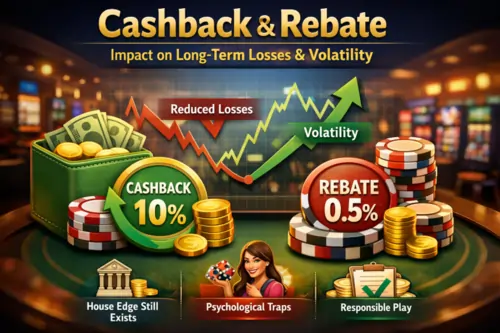
Online casinos love to promote cashback and rebate systems as ways to “reduce losses” or “play longer.” Sounds shiok, right? But how much do they really help your long-term losses and volatility?
Let’s break it down in simple terms — no confusing math, no marketing fluff.
What Is Cashback?
Cashback is a percentage of your net losses returned to you over a period (day, week, month). It is calculated on what you lost, not how much you bet.
If you want a basic intro to house edge vs Return to Player (RTP), you can check this guide from Outplayed: what is house edge.
Example:
- You deposit $1,000.
- After a week, you are down $400.
- Casino offers 10% weekly cashback.
- You receive $40 back.
So you still lost $360. Cashback softens the loss a bit, but it doesn’t erase it.
What Is a Rebate?
A rebate is paid on turnover (total bets placed), not just losses.
Example:
- You bet $10,000 total (win or lose).
- Rebate rate = 0.5%.
- You receive $50 rebate.
Even if you break even or win slightly, you still get the rebate because it is based on total wagering, not the final result.
Long-Term Losses: House Edge and Expected Loss
To understand long-term impact, you need to know:
- House edge: Built-in advantage the casino has on each game.
- Expected loss: Average you lose over many bets.
- Volatility: How wild the swings (ups and downs) feel.
Typical house edges:
- Slots: about 3%–6%.
- Blackjack with basic strategy: about 0.5%–2%.
- Roulette: about 2.7%–5.26%.
For another explanation with real examples (roulette, slots, RTP vs edge), see: house edge.
If a slot has a 5% house edge, over the long run you expect to lose around $5 per $100 wagered. Cashback does not remove this edge; it only shaves it down slightly.
How Cashback Changes the Math
Scenario:
- Total wagered: $10,000.
- House edge: 5%.
- Expected loss: $500.
If the casino gives 10% cashback on net losses:
- Cashback: 10% of $500 = $50.
- New expected loss: $500 − $50 = $450.
- Effective house edge: 4.5% instead of 5%.
So yes, cashback lowers your expected loss a bit — but you are still losing in the long run. It doesn’t magically turn the game into a profitable system for you.
How Rebates Affect Losses and Volatility
Rebates work similarly in expectation: they reduce your effective house edge slightly, but not enough to make you a long-term winner in most cases.
Example:
- You wager $10,000.
- House edge: 5% → expected loss $500.
- Rebate: 0.5% of turnover = $50.
- New expected loss: $500 − $50 = $450.
Again, same 10% reduction of the loss, same 4.5% effective edge, just like with cashback — but the rebate is based on betting volume, so it feels like you “earn” something every time you play.
Volatility: What Actually Changes?
Volatility is about how often you win and how big the swings are.
- High volatility: fewer hits, but potentially bigger wins and bigger downswings.
- Low volatility: more frequent, smaller wins, smoother ride.
For a simple explanation with slot examples, see: understanding slots volatility.
Cashback and rebates:
- Slightly reduce downside volatility because some of your losses are refunded.
- Do not change the core game variance — big swings, jackpots, and dry streaks are still there.
- Do not increase your chance of winning the game long term.
Example:
- You lose $1,000 in a week.
- 10% cashback gives you $100 back.
- Real loss = $900.
The downswing is softer, but you still took a serious hit.
Cashback and Rebate Systems: The Psychological Trap
This is where many players get caught.
Cashback and rebates can:
- Make losses feel “discounted” (“Never mind, got cashback.”).
- Encourage higher turnover to “maximize rewards.”
- Encourage chasing losses (“I almost get something back anyway.”).
Research on gambling promotions and loyalty programs shows that bonuses and incentives can nudge players to gamble longer or spend more than planned.
If you want a more formal responsible gambling overview, you can visit the National Council on Problem Gambling: responsible gambling.
Mathematically, nothing changed: the house still has the edge. Emotionally, it feels safer than it really is.
Can Cashback or Rebates Make You Profitable?
Most of the time, no.
In theory:
- If total rewards (cashback + rebate + other promos) are higher than the house edge, the game could become positive expectation.
- Example: Game house edge 3%, total rewards 4% → you would have a small edge in theory.
In reality for the average player:
- Rewards are usually well below the game’s house edge.
- There are caps, tiers, and VIP levels.
- Some bets or games do not fully qualify.
- Promotions can be changed or withdrawn anytime.
So for normal players, long-term expectation stays negative.
Using Cashback Wisely (If You Choose to Play)
If you still choose to play, you can treat cashback and rebates as risk-reduction tools, not profit engines.
Better practices:
- Prefer low house-edge games (e.g., blackjack with basic strategy, good baccarat bets) rather than high-edge, high-volatility slots.
- Set a fixed bankroll and stick to it; treat cashback as a bonus on top, not a way to chase back losses.
- Avoid increasing your bet size just to unlock higher tiers or more rebate.
- Keep track of total wagering so you see the real cost behind that “free” cashback.
Quick Comparison Example
Effect of 10% cashback on expected loss (5% house edge)
| Scenario | No Cashback | 10% Cashback |
|---|---|---|
| Total wagered | $10,000 | $10,000 |
| House edge | 5% | 5% |
| Expected loss | $500 | $500 |
| Cashback | $0 | $50 |
| Final loss | $500 | $450 |
You are getting 10% of your loss back, not 10% of your total bankroll. Big difference.
Long-Term Reality and Responsibility
Say over 1 year you wager $200,000 on games with an average 5% house edge:
- Expected loss: $10,000.
- With 10% cashback on net losses, you might recover around $1,000.
- Net loss still around $9,000.
For players in the Philippines, PAGCOR also has a simple Responsible Gaming page with tips and self-exclusion info: responsible gaming.
For players, the key is simple:
- Treat gambling as paid entertainment, not an investment.
- Use limits and stop when you hit them.
- See cashback as a small discount on entertainment, not a recovery plan.
If you tell me your exact publishing platform (blog/Medium/Telegram/Facebook), I can tweak link formatting (anchor text vs full URL) to match that style.