

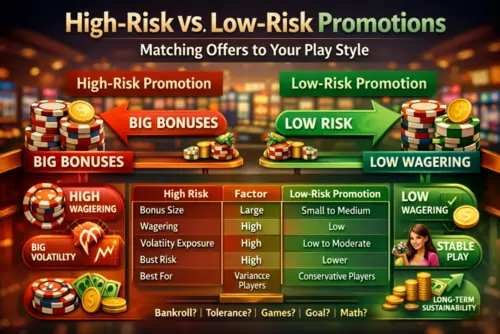
Choosing the wrong casino promotion can quietly increase your losses instead of improving your value. Some bonuses are high-risk, high-reward, while others are built for steady, low-volatility play. Understanding the difference between high-risk vs low-risk casino promotions helps you protect your bankroll and match promos to your own risk tolerance.
high-risk vs low-risk casino promotions
High-Risk vs Low-Risk Promotions
- High-risk promotions
- Large bonus percentages
- High wagering requirements (rollover)
- Often tied to volatile games (e.g., high-volatility slots)
- Higher exposure to house edge and variance
- Low-risk promotions
- Smaller, more realistic bonuses
- Lower wagering requirements
- Cashback or rebates on losses
- Focus on sustainability and lower volatility
If you are new to wagering requirements, this beginner-friendly guide is useful: wagering requirements guide beginners.
The best promotion depends on your bankroll size, preferred games, and how much variance you can emotionally and financially handle.
What Is a Promotion Risk Profile?
A promotion’s risk profile is how much financial and volatility exposure it creates for you. It is mainly shaped by:
- Wagering requirements (e.g., 10x, 30x, 50x)
- Bonus size and whether wagering applies to bonus only or bonus + deposit
- Eligible games and their contribution percentages
- Maximum bet limits during bonus play
- Volatility of the games you use to clear the bonus
- Withdrawal caps and time limits
Higher wagering + higher volatility = higher risk of busting before you can cash out. For a deeper breakdown of how bonus terms work, see: guide to reading and understanding casino bonus terms.
High-Risk Promotion Profile
Typical high-risk promotions include:
- 100%–300% deposit match bonuses
- 30x–60x wagering requirements (often on bonus or bonus + deposit)
- Limited eligible games, often high-volatility slots
- Strict max bet rules (e.g., max $5–$10 per spin)
- Tight withdrawal caps on bonus winnings
Example: High-Risk Bonus Math
- Deposit: $500
- Bonus: 200% = $1,000
- Total balance: $1,500
- Wagering: 40x bonus = $40,000 required turnover
If your main game has a 4% house edge, your expected loss on that turnover is:
- Expected loss = $40,000 × 4% = $1,600
That expected loss is higher than your starting $1,500 balance, which means statistically most players will bust before finishing the wagering. This is why many large-match, high-risk casino promotions look attractive but are tough to clear in practice.
For more examples of how wagering multiples affect your odds, see: what are wagering requirements.
Who Might Consider High-Risk Promos?
High-risk profiles may suit players who:
- Enjoy high-volatility slots and big-win potential
- Accept long losing streaks and big swings
- Have larger, truly disposable bankrolls
- Play mainly for entertainment and “shots” at big outcomes
If you’re chasing variance and can afford to lose, high-risk promos can be fun — but only with strict bankroll limits and realistic expectations.
Low-Risk Promotion Profile
Low-risk promotions aim for stability and survivability rather than maximum adrenaline. They’re the “value” side of high-risk vs low-risk casino promotions.
They often include:
- 10%–50% deposit bonuses
- 5x–20x wagering requirements
- Cashback on net losses (daily, weekly, or monthly)
- Ongoing reload bonuses and rebate systems
- Wider game eligibility, including lower-volatility titles
Example: Low-Risk Bonus Math
- Deposit: $500
- Bonus: 25% = $125
- Wagering: 10x bonus = $1,250 turnover
At a 4% house edge:
- Expected loss = $1,250 × 4% = $50
You are risking much less turnover for the bonus, meaning lower expected loss and a higher chance of still having a playable balance after wagering.
Who Should Choose Low-Risk Promos?
Low-risk profiles tend to suit:
- Conservative or recreational players
- Blackjack, baccarat, or lower-volatility slot players
- Small to medium bankrolls
- Players who care about long-term play and bankroll sustainability
If you prefer steady sessions and less stress, low-risk structures make far more sense.
High-Risk vs Low-Risk Casino Promotions Volatility and Bonus Clearance
Volatility is critical when it comes to clearing wagering:
- High-volatility games
- Larger but less frequent wins
- Long dry streaks
- High chance of busting before meeting rollover
- Low-volatility games
- Smaller, more regular wins
- More stable balance
- Better survival probability during wagering
For most bonus clearance, survival matters more than chasing jackpots. Low- or medium-volatility options often give you the best chance to actually finish wagering. For a simple explanation of volatility, check: low vs high volatilityslots
Expected Value (EV): The Real Bonus Value
Every game carries a house edge. Promotions only help if the value they add meaningfully offsets your exposure to that edge.
- If house edge ≈ 3% and effective bonus value ≈ 2%, you still have a negative expectation.
- High-risk bonuses create large total turnover, increasing total expected loss to the house edge.
- Lower-risk bonuses with modest wagering keep total turnover smaller, so you risk less per bonus dollar.
A key takeaway:
A $100 bonus with 20x wagering can be better value than a $500 bonus with 50x wagering, because you risk much less total turnover to “unlock” each bonus dollar.
Psychological Risk Factors
Promotions don’t just affect math — they affect behavior.
High-risk promos can:
- Encourage bigger bet sizes (“must clear wagering fast”)
- Create urgency and FOMO due to time limits
- Increase emotional stress and tilt when the balance swings hard
Low-risk promos can:
- Support more controlled bet sizing
- Give flexibility to stop without feeling “trapped” by huge rollover
- Help maintain a calmer mindset and better bankroll discipline
For guidance on using match bonuses responsibly, see: how to use match bonuses
Promos should enhance entertainment, not push you into anxious or compulsive play.
Compliance and Responsible Gambling
From a regulatory and player-protection angle, always check:
- How wagering is calculated (bonus only vs bonus + deposit)
- Game contribution percentages for slots vs table games
- Maximum bet limits while a bonus is active
- Bonus expiry dates and time limits
- Maximum withdrawal caps on bonus winnings
Some research and regulators have raised concerns about very high wagering requirements combined with time pressure, as they can drive higher-intensity play and overspending. Best-practice guidance is clear: you should not increase bet size purely to “force” bonus clearance.
Bonuses are marketing tools, not guaranteed profit systems.
High-Risk vs Low-Risk Promotions (At a Glance)
| Factor | High-Risk Profile | Low-Risk Profile |
|---|---|---|
| Bonus size | Large (100%–300% match) | Small to medium (10%–50% match) |
| Wagering | High (30x–60x) | Lower (5x–20x) |
| Volatility exposure | High (often high-volatility slots) | Low to moderate |
| Bust risk | High | Lower |
| Best for | High-variance seekers, big-win chasers | Conservative, long-term recreational players |
| Bankroll fit | Medium–large disposable bankrolls | Small–medium bankrolls |
| Sustainability | Lower | Higher |
This table is a quick snapshot of high-risk vs low-risk casino promotions so you can instantly see which side fits your style.
How to Match Promotions to Your Play Style
Ask yourself:
- What is my real bankroll, and can I afford to lose it?
- Can I tolerate long losing streaks without tilting?
- Do I prefer slots or table games?
- Am I playing mainly for entertainment or chasing big scores?
- Do I fully understand how the rollover math works on this offer?
If you value structure, control, and longevity, low-risk promos are usually the better choice. If you actively enjoy variance and can genuinely afford big swings, carefully selected high-risk promos might fit — but always within strict, pre-set limits.
Common Mistakes to Avoid
- Grabbing the highest percentage bonus without reading wagering and caps
- Ignoring game contribution rates and using the wrong games to clear
- Increasing bet size to “clear faster” and blowing the bankroll
- Not calculating total required turnover and expected exposure
- Treating any bonus as a guaranteed profit opportunity
Read first, claim later.
Final Summary
high-risk vs low-risk casino promotions offer big headline numbers and excitement but also increase volatility, total exposure, and bust probability. Low-risk promotions prioritize sustainability, smaller expected losses, and better bankroll control.
The best promotion is not the biggest one — it is the one that aligns with your risk tolerance, bankroll, and long-term goals. When comparing high-risk vs low-risk casino promotions, choose based on math and terms, not marketing copy, and always keep play within responsible limits.