

The FIFA World Cup is football’s ultimate stage. Every four years, nations compete for glory — but only a select few teams achieve true dominance.
When ranking the greatest World Cup teams ever by performance, we look beyond trophies and hype. We consider:
- Win percentage
- Goal difference
- Defensive record
- Tactical innovation
- Strength of opponents
- Historical impact
Some teams win.
Some teams define eras.
The Greatest World Cup Teams Ever Ranked
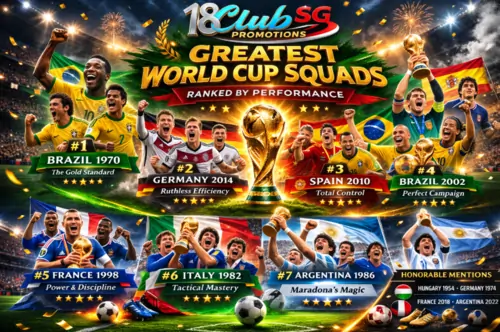
Here are the greatest World Cup teams of all time, ranked primarily on how convincingly they dominated their tournaments. If you want a broader context first, the history of the FIFA World Cup is a useful overview of how the tournament has evolved.
1. Brazil 1970 – The Blueprint of Attacking Football
Brazil’s 1970 team remains the benchmark of World Cup greatness. Managed by Mário Zagallo, this legendary team featured Pelé, Jairzinho, Rivellino, Tostão, and Carlos Alberto Torres.
Brazil 1970 combined technical brilliance, fluid movement, and outstanding chemistry. Their fourth goal in the final — finished by Carlos Alberto after a flowing team move — is still shown in coaching seminars as an example of collective attacking play.
To understand why Pelé is so central to this team’s aura, you can read his detailed biography on Encyclopaedia Britannica. They did not just win the World Cup — they redefined what attacking football could look like on the biggest stage.
2. Germany 2014 – Ruthless Modern Dominance
Germany’s 2014 World Cup team represents the peak of modern tactical evolution and team depth.
- 18 goals scored
- Only 4 goals conceded
- Historic 7–1 semi-final victory over Brazil on home soil
Their 7–1 win over Brazil remains the most shocking and dominant World Cup semi-final ever, with Germany leading 5–0 inside 29 minutes. For a match-level breakdown of that night in Belo Horizonte, BBC Sport’s analysis of the game offers extra tactical detail. Joachim Löw’s side blended pressing, flexible positioning, and quick vertical attacks with a strong spine from defence to attack.
Manuel Neuer helped popularise the “sweeper-keeper” role at tournament level, often operating outside his box to compress space and start counter-attacks. Clinical, efficient, and mentally relentless — Germany 2014 set a new standard for modern World Cup dominance.
3. Spain 2010 – The Era of Total Control
Spain 2010 mastered possession football like no team before them.
Built around the tiki-taka principles developed at FC Barcelona, Spain suffocated opponents with short passing, pressing, and positional rotations. UEFA’s technical articles on tiki-taka and Barcelona’s dominance offer useful background on how this style was refined at club level. Xavi and Andrés Iniesta dictated tempo and space, making it extremely difficult for opponents to create clear chances.
Some critics labelled them overly cautious, but the performance data — territory, pass completion, and shot control — shows dominance through control rather than high scorelines. In tournament football, that level of control is a form of power.
4. Brazil 2002 – Perfect Record, Maximum Impact
Brazil’s 2002 team delivered a flawless campaign across Asia.
The “Three R’s” — Ronaldo, Rivaldo, and Ronaldinho — formed one of the most feared attacking trios in World Cup history, combining speed, individual flair, and ruthless finishing. For more on Ronaldo’s journey from serious knee injuries to 2002 redemption, his profile on Britannica is a good starting point.
Behind them, Brazil had a solid defensive base and balanced midfield that allowed their stars to express themselves without losing structure. Coming after the disappointment of 1998 and Ronaldo’s health issues, this run felt like a statement of restoration as much as dominance. On performance alone, few World Cup winners have been more convincing across an entire tournament.
5. France 1998 – Defensive Discipline and Home Glory
France 1998 built their success on organisation, depth, and defensive excellence.
With Marcel Desailly, Laurent Blanc, and Lilian Thuram, France’s back line was among the most disciplined in World Cup history. In midfield, Didier Deschamps, Emmanuel Petit, and others provided balance that allowed Zinedine Zidane to influence games in key moments.
UEFA’s profiles and features on Zidane highlight how his elegance and decision-making defined both club and country during this era. They were not always the most flamboyant side, but in terms of structure, control of space, and resilience — especially under home pressure — their performance level was elite.
6. Italy 1982 – Tactical Timing Masterclass
Italy’s 1982 team showed how momentum and timing can define a tournament.
- Eliminated reigning champions Argentina and favourites Brazil in a brutal second group phase
- Defeated West Germany 3–1 in the final
After a slow start, Italy grew into the tournament, with Paolo Rossi exploding into form in the decisive matches. Detailed player statistics on sites like Transfermarkt help show how Rossi’s goals clustered at exactly the right time for Italy.
Their compact defensive shape, counter-attacking threat, and big-game mentality peaked against the strongest opposition. Sometimes a slow group stage does not matter — what counts is reaching your highest level when the knockout rounds begin. Italy 1982 are a classic example of a team timing its run to perfection.
7. Argentina 1986 – Maradona’s Tournament
Argentina 1986 are inseparable from Diego Maradona, whose individual World Cup may never be matched.
Maradona operated as playmaker, dribbler, and finisher, repeatedly breaking defensive structures almost single-handedly. For a fuller picture of his career and club impact at Napoli and Boca Juniors, the biography on FootballHistory.org is a concise reference.
Yet this was also a well-drilled side that gave him the platform to dominate, with a hard-working midfield and organised defence behind him. His performances elevated a strong team into something unforgettable, turning Argentina 1986 into one of the most iconic World Cup-winning teams in history.
Honorable Mentions
These teams narrowly miss the main list but delivered exceptional tournament performances:
- Hungary 1954 – Scored 27 goals in just 5 matches, the most ever by a team in a single World Cup, and finished with a +17 goal difference.
- West Germany 1974 – Blended discipline and efficiency, winning the title on home soil against Johan Cruyff’s Netherlands.
- France 2018 – Combined youth, athleticism, and tactical flexibility, scoring 14 goals en route to the trophy.
- Argentina 2022 – Lionel Messi’s crowning World Cup, with a side that mixed pressing, intensity, and clutch performances in shootouts and tight games.
For a structured recap of how World Cups from 1998 to 2022 unfolded, FIFA’s own historical pieces on recent tournaments are worth checking. All of these teams showed tournament-level dominance and remain central to debates about the greatest World Cup teams ever.
Why Performance Metrics Matter
When ranking the greatest World Cup teams, relying only on titles or nostalgia can be misleading. Performance-based analysis provides a clearer picture of how dominant a team really was against its contemporaries.
Key metrics include:
- Goal difference and goals per game
- Defensive consistency and clean sheets
- Win percentage and strength of opponents faced
- Tactical identity and innovation
- Lasting influence on how future teams play
Football evolves, but true dominance leaves evidence in both numbers and legacy. If you want more general background on the tournament’s structure and records, Britannica’s overview of the World Cup in football is a solid reference.
If you enjoy digging into numbers and structured analysis beyond just football, you might also like the analytical breakdowns on 18Club SG Promotions, which reviews real-money gaming promotions with a focus on transparency and risk.
Explore More Sports & Entertainment Insights
Major tournaments shape global fan engagement, media narratives, and betting markets. Understanding which teams truly dominated helps explain why certain eras, players, and teams attract such intense attention.
For more football discussions and promotional insights, visit: 18clubsgpromotions
To learn more about responsible gaming practices, visit: responsible-gaming
Different eras bring different styles.
Brazil brought flair.
Germany brought efficiency.
Spain brought control.
Italy brought tactical mastery.
The debate over the greatest World Cup teams of all time will never fully end — and that is part of football’s beauty. What does not change is this: true greatness is not only about lifting the trophy; it is about how convincingly you dominate the world stage.