

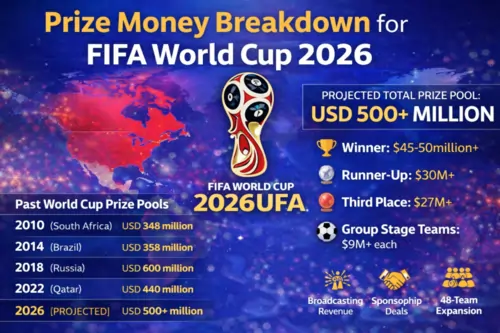
The FIFA World Cup 2026 will be the largest tournament in football history, featuring 48 teams across the United States, Canada, and Mexico. One of the biggest questions for fans, players, and federations is simple: How much world cup 2026 prize money is at stake?
All figures are based on official FIFA announcements and reputable financial reporting from previous tournaments. For official documents and updates, see the FIFA official website.
If you also want to understand how this record prize pool fits into the expanded tournament structure, check our in-depth guide on the World Cup 2026 format and qualified teams.
Total Confirmed Prize Money for World Cup 2026
FIFA has approved a record-breaking financial package of USD 727 million to be distributed to participating national associations at World Cup 2026.
- USD 655 million will be paid out as performance-based prize money among the 48 teams.
- Every qualified team will also receive USD 1.5 million in preparation money, guaranteeing at least USD 10.5 million per team in total.
This represents roughly a 50% increase on the USD 440 million prize pool at Qatar 2022.
Historical Growth of World Cup Prize Money
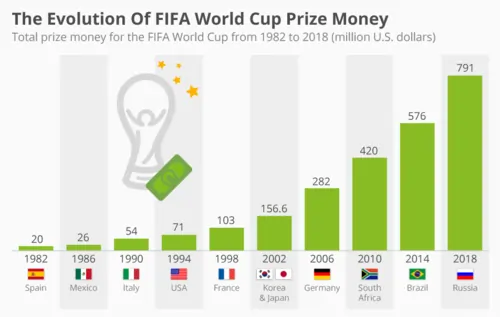
World Cup prize money has risen sharply as broadcasting, sponsorship, and commercial revenues have grown.
Approximate total prize pools:
- 2010 (South Africa): USD 348 million
- 2014 (Brazil): USD 358 million
- 2018 (Russia): USD 400 million
- 2022 (Qatar): USD 440 million
- 2026 (USA/Canada/Mexico): USD 655 million in prize money, USD 727 million total distribution (official).
Growth is driven by:
- Higher global broadcast rights fees
- Larger sponsorship and marketing deals
- More matches and more inventory in an expanded 48‑team format
How FIFA Distributes World Cup Prize Money
FIFA pays prize money to participating member associations (national federations), not directly to players. Distribution is based on:
- Stage reached
- Final ranking
- Guaranteed participation
Every qualified team receives money even if eliminated in the group stage; the deeper a team progresses, the greater the payout.
Reference: Official 2022 Prize Breakdown
For context, Qatar 2022 used this distribution:
- 🏆 Winner: USD 42 million
- 🥈 Runner-up: USD 30 million
- 🥉 Third place: USD 27 million
- Fourth place: USD 25 million
- Quarterfinalists (5th–8th): USD 17 million
- Round of 16 (9th–16th): USD 13 million
- Group-stage teams: USD 9 million each
Total prize pool in 2022: USD 440 million.
Official Stage-by-Stage Prize Money for World Cup 2026
FIFA has confirmed the exact performance-based payouts for 2026.
World Cup 2026 Prize Money
- 🏆 Champion: USD 50 million
- 🥈 Runner-up: USD 33 million
- 🥉 Third place: USD 29 million
- Fourth place: USD 27 million
- 5th–8th place (quarterfinalists): USD 19 million
- 9th–16th place (Round of 16): USD 15 million
- 17th–32nd place (Round of 32): USD 11 million
- 33rd–48th place (group-stage exit): USD 9 million
On top of this, every team receives USD 1.5 million in preparation money, so even a team that exits in the group stage earns USD 10.5 million total.
Key changes vs 2022:
- Winner’s payout rises from USD 42m to USD 50m.
- Overall prize pool increases by about 50%, matching FIFA’s record funding decision.
Why Prize Money Keeps Increasing
Several structural factors drive this continuous growth:
- Broadcasting Rights
World Cup media rights are FIFA’s largest revenue source, with broadcasters worldwide paying premium fees for live coverage. - Commercial Sponsorship & Marketing
Global and regional sponsors across sectors like technology, automotive, finance, and consumer goods invest heavily in tournament exposure. - Expanded Tournament Format
The 48‑team format adds more matches and more ticketed events, increasing ticketing, hospitality, and advertising inventory.
As revenue grows, FIFA can raise prize money and other distributions while still funding broader development programs.
How Revenue Funds the Prize Pool
World Cup revenue flows mainly from:
- Media rights
- Marketing and sponsorship rights
- Ticket sales and hospitality
- Licensing and merchandising
These cycles generate the bulk of FIFA’s four‑year budget, which then supports:
- Prize money
- Club compensation schemes
- Development and solidarity programs worldwide
Do Players Receive the Full Prize Money?
No. FIFA pays prize money to national associations, which then decide how to distribute funds.
Federations typically:
- Negotiate bonus agreements with players and staff
- Define performance-based rewards (per win, per stage)
- Allocate shares for coaches and backroom staff
So players do receive substantial bonuses, but always through their federation’s internal agreements, not directly from FIFA.
Club Benefits Programme
Separate from national-team prize money, FIFA runs a Club Benefits Programme to compensate clubs that release players for the World Cup.
This is important because:
- Clubs assume injury and fatigue risks when players travel.
- Domestic leagues adjust schedules for the tournament.
Payments are calculated based on:
- Number of players participating
- Duration of each player’s stay in the competition
- Daily compensation rates set by FIFA
This programme is funded from overall World Cup revenues and operates independently from prize money to federations.
Economic Impact of World Cup 2026
Beyond direct FIFA distributions, World Cup 2026 is expected to generate:
- Billions in tourism and hospitality spending
- Infrastructure and stadium investment in host cities
- Increased global commercial exposure for hosts and participants
For participating nations, qualification alone can:
- Improve sponsorship and broadcast deals
- Strengthen federation budgets
- Support grassroots and youth development programs
For smaller football nations, simply reaching the finals can be financially transformative.
What the 48‑Team Expansion Means Financially
The expanded format reshapes financial distribution in three main ways:
- Wider Revenue Sharing
More teams receive guaranteed minimum payouts and preparation funds. - Increased Early-Stage Funding
Teams finishing 33rd–48th earn USD 9m plus preparation money, giving emerging football nations more financial support. - Maintained Competitive Incentives
The top of the payout structure remains heavily weighted, with USD 50m for the champion and strong rewards through to the semifinals.
This model balances wider financial inclusion with strong performance incentives.
Transparency & Official Sources
Official prize money and financial figures are communicated through:
- FIFA Council decisions and press releases
- Financial reports and budget projections
- Official media statements and Congress documents
For the latest official data, always refer to: fifa.
World Cup 2026 will combine record prize money, expanded global participation, and unprecedented commercial scale, making it the most financially significant edition in tournament history.