


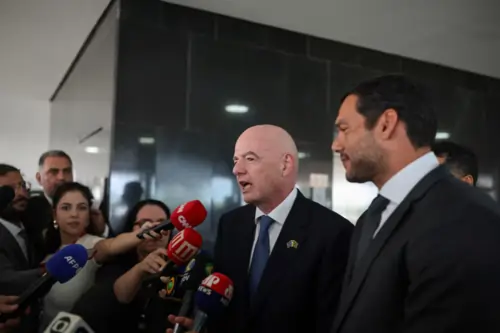
Brazils Bid for the 2029 Club World Cup was confirmed after a high‑level meeting in Brasília involving FIFA president Gianni Infantino and Brazilian president Luiz Inácio Lula da Silva. Also present were Sports Minister André Fufuca, Brazilian Football Confederation (CBF) president Samir Xaud, and Brazil men’s national team coach Carlo Ancelotti, underscoring how seriously the country is treating the opportunity.
Speaking to Brazil’s official news agency, Xaud said that Brazil “is capable of hosting this grand event” but stressed that the project will require major discussions and adjustments before a full technical dossier is submitted. Brazil has already communicated its interest directly to FIFA, making it one of the first countries to publicly state its intention to stage the 2029 edition. However, FIFA has not yet formally opened the bidding process for 2029, so Brazil’s move is an early positioning step rather than a confirmed hosting decision.
Once FIFA publishes the official bid regulations, interested countries will need to submit detailed proposals covering stadiums, infrastructure, security, transport, accommodation, and commercial guarantees. Brazil’s authorities and the CBF will have to align on financial responsibilities, timelines, and legacy plans before locking in a final bid.
Brazil’s plan to bid for the 2029 FIFA Club World Cup was confirmed after a high‑level meeting in Brasília involving FIFA president Gianni Infantino and Brazilian president Luiz Inácio Lula da Silva, as first reported by Reuters
The New Club World Cup: What 2029 Will Look Like
The 2029 tournament is currently expected to be the second edition of the revamped FIFA Club World Cup, which runs on a four‑year cycle and features 32 teams in a World Cup‑style format. The first expanded edition took place in the United States and was broadly welcomed by clubs, confederations, and fans for its competitive structure and commercial impact.
Under the current model:
- 32 clubs qualify from all six confederations, plus one club from the host nation.
- Slot allocation is: 12 UEFA clubs, 6 from CONMEBOL, 4 each from AFC, CAF and CONCACAF, 1 from OFC, and 1 from the host association.
- Teams are drawn into 8 groups of 4, each playing three group‑stage matches.
- The top two in each group advance to the Round of 16, followed by quarter‑finals, semi‑finals and a one‑off final.
Early indications suggest FIFA intends to retain this 32‑team structure for 2029, given its strong broadcast performance and sponsor interest. The prize pool is expected to at least match, and possibly exceed, the record levels seen at the inaugural expanded tournament, further cementing the Club World Cup as one of the most lucrative competitions in world football.
Many of the venues named for the 2027 FIFA Women’s World Cup – including the Maracanã, Mineirão, Estádio Nacional and Beira‑Rio – are already confirmed by ESPN’s coverage of the 2027 Women’s World Cup venues.
Why Brazils Bid for the 2029 Club World Cup
For Brazil, the 2029 Club World Cup represents both a sporting showcase and a strategic move in global football politics.
- Extending a Run of Major Tournaments
Brazil has recent experience staging high‑profile events, including:
- 2013 FIFA Confederations Cup
- 2014 FIFA World Cup
- 2019 Copa América
In 2027, it will also host the FIFA Women’s World Cup – the first time that tournament has been held in South America – with 32 teams playing across eight host cities between late June and late July. Securing the 2029 Club World Cup would extend this sequence and keep Brazil in the global spotlight across both the men’s and women’s game.
- Leveraging Existing Stadium and Transport Infrastructure
Many of Brazil’s major stadiums – such as Rio de Janeiro’s Maracanã, São Paulo’s main arenas, Brasília’s Estádio Nacional and Porto Alegre’s Beira‑Rio – were upgraded for the 2014 World Cup and other recent events. This gives Brazil a strong base for hosting a Club World Cup likely spread across multiple major cities, although some maintenance and modernisation would still be required. - Economic and Tourism Upside
A 32‑team Club World Cup scheduled in the June–July window would bring tens of thousands of visiting supporters, plus global media, content creators and sponsors. Brazilian authorities are betting that increased tourism, hotel occupancy, local spending and long‑term destination branding will outweigh the costs of hosting, especially if existing infrastructure can be reused efficiently. - Sporting Prestige and a Boost for Domestic Football
Hosting the premier global club competition would raise the profile of Brazilian domestic football and its leading clubs. Giants such as Flamengo, Palmeiras, Fluminense, Corinthians and others could benefit from higher international visibility, stronger commercial partnerships and extra motivation to qualify and compete on home soil. Xaud has argued that Brazilian football is “showing its potential” in the new Club World Cup and that staging the tournament would reflect that status.
For readers who want more technical detail on qualification and seeding, see FIFA’s dedicated Club World Cup explainer.
Lula, Infantino and a Deepening Relationship
Gianni Infantino’s visit to Brazil was about more than a single tournament bid. His meetings with Lula, Ancelotti and Brazil’s sports leadership also covered:
- The launch, branding and planning for the 2027 Women’s World Cup.
- Infrastructure and host‑city coordination for that tournament.
- Long‑term cooperation on football development projects in Brazil and across South America.
Infantino has repeatedly praised Brazil’s passion for football and its capacity to stage large events, while Brazilian officials have emphasised that they want the country to occupy a central place in FIFA’s tournament calendar. The 2029 Club World Cup bid fits into this broader attempt to deepen Brazil’s institutional relationship with FIFA.
Competition From Other Potential Hosts
Despite suggestions on social media that Brazil could be the “sole candidate,” major outlets expect rival bids to emerge. Countries mentioned as likely or interested contenders include:
- Spain, which will co‑host the 2030 men’s World Cup alongside Morocco and Portugal.
- Morocco, whose recent record hosting club, youth and continental tournaments has raised its profile within FIFA.
- Qatar, which successfully staged the 2022 men’s World Cup and continues to invest heavily in major events.
The Club World Cup host selection is now decoupled from the senior men’s World Cup process, so the 2030 hosts do not automatically gain an advantage for 2029. Instead, FIFA will assess bids on factors such as stadium quality, logistics, financial guarantees, time‑zone suitability for global audiences, and overall commercial impact.
What FIFA Will Look For – And What Comes Next
While detailed bid criteria for 2029 have not yet been published, FIFA’s usual requirements for major tournaments include:
- A sufficient number of high‑capacity, modern stadiums, with training facilities nearby.
- Strong transport infrastructure, including international airports and reliable domestic air, rail and road links.
- Adequate accommodation in host cities for teams, officials, media and travelling fans.
- Robust security and safety plans for stadiums, training sites and fan zones.
- Proven capacity to manage global media, broadcasting operations and commercial partners at scale.
Brazil’s bid is likely to emphasise that much of this framework already exists thanks to the 2014 World Cup and the forthcoming 2027 Women’s World Cup, while acknowledging that some stadium and transport upgrades will be needed.
In the short term, Brazil’s announcement achieves three things:
- It puts pressure on potential rivals by forcing them to clarify their intentions earlier than planned.
- It signals continuity to FIFA, showing that Brazil views the 2027 Women’s World Cup as the start of a wider hosting cycle rather than a one‑off event.
- It generates internal momentum, helping the government and the CBF build political and public support for another major tournament.
Once FIFA formally opens the bidding process, Brazil will need to submit a comprehensive dossier and navigate a competitive evaluation before any decision is taken. Final confirmation of the 2029 host is expected closer to the end of the decade, giving the selected country several years to prepare.