

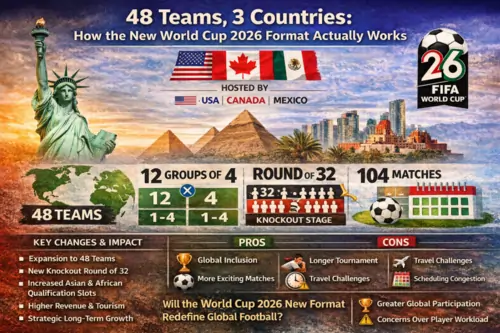
The FIFA World Cup 2026 Format is not just bigger; it is structurally different. For the first time in history:
- 48 teams will compete
- 12 groups will be used
- 32 teams will enter the knockout stage
- 104 total matches will be played over about 39 days
- 3 countries (United States, Canada, Mexico) will host the tournament across 16 venues
This is the largest expansion since 1998, when FIFA moved from 24 to 32 teams. If you want official high‑level details, FIFA’s own World Cup 2026 hub outlines hosts, venues, and key dates. On our side at 18Club SG Promotions, we’ll be tracking how this new format affects scheduling, regional teams, and fan experience throughout the tournament.
Why FIFA Expanded to 48 Teams
FIFA officially approved the expansion in 2017 during a Council decision that reshaped the World Cup from 2026 onward. The main objectives were to:
- Increase global representation
- Expand qualification slots for Asia, Africa, and CONCACAF
- Grow football markets in North America
- Increase broadcasting and sponsorship revenue
- Strengthen long‑term financial sustainability
Football is no longer limited to traditional powerhouses in Europe and South America; growth markets now include Asia, the Middle East, and North America. From a governance perspective, the expansion is both a sporting decision and a commercial strategy, and independent analyses have also emphasized how extra slots for AFC, CAF, and CONCACAF are meant to rebalance representation that was historically dominated by Europe and South America.
How the 48‑Team World Cup 2026 Format Actually Works

Step 1: Group Stage Structure
There will be:
- 12 groups
- 4 teams per group
- Each team plays 3 matches
The traditional points system remains unchanged:
- Win = 3 points
- Draw = 1 point
- Loss = 0 points
This keeps the group stage familiar and simple for fans and teams.
Step 2: Qualification from Groups
From each group:
- Top 2 teams qualify automatically (12 × 2 = 24 teams)
- Best 8 third‑placed teams across all groups also qualify
Total advancing to knockout stage:
- 32 teams enter the Round of 32
This structure keeps competitive tension high for third‑placed teams too, since performance across all groups can still secure progression.
FIFA initially proposed 16 groups of 3 teams, but concerns about possible match manipulation in final group games led to the adoption of the 12‑group, 4‑team format to protect competitive integrity. External explainers from major outlets echo this reasoning and highlight the fairness benefits of keeping four‑team groups.
Step 3: Introduction of the Round of 32
Previous World Cup format (32 teams, 1998–2022):
- Group Stage → Round of 16 → Quarterfinals → Semifinals → Final
New format (48 teams, from 2026):
- Group Stage → Round of 32 → Round of 16 → Quarterfinals → Semifinals → Final
This change increases total matches from 64 in Qatar 2022 to 104 in 2026. More knockout matches mean more high‑stakes games for fans, but also more minutes and travel for players who go deep into the tournament.
Old vs New: Format at a Glance
| Feature | Old format (1998–2022) | 2026 format |
|---|---|---|
| Teams | 32 | 48 |
| Groups | 8 groups of 4 | 12 groups of 4 |
| Knockout start | Round of 16 | Round of 32 |
| Total matches | 64 | 104 |
| Hosts | Usually 1 country | 3 (USA, Canada, Mexico) |
| Duration | ~29–32 days | ~39 days |
| Venues | 8–12 typically | 16 venues across North America |
Several neutral guides present similar old‑vs‑new tables so fans can quickly see how 2026 compares to the 32‑team era.
Why Three Host Countries?
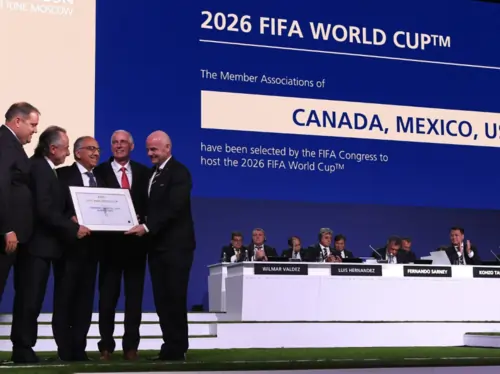
World Cup 2026 will be hosted by:
- United States
- Canada
- Mexico
This is the first tri‑nation hosting model in World Cup history.
Why It Was Necessary
With 48 teams and 104 matches, a single host nation would face major challenges in:
- Stadium capacity and quality
- Transportation and internal travel
- Accommodation and training facilities
- Fan‑zone and security logistics
North America collectively offers:
- Large, modern stadiums (including NFL venues in the USA)
- Strong airport and transport infrastructure
- Established tourism industries
- High commercial market value, especially in the US sports market
The United States will host the bulk of matches, including the final stages, while Mexico becomes the first country to host three World Cups (1970, 1986, 2026), a historically significant milestone. Fans planning travel can also use official schedule and travel resources that map fixtures to cities and regions.
Travel & Scheduling Challenges
Because the United States, Canada, and Mexico are geographically large, travel distances and time zones matter. Key challenges include:
- Long flight times between certain host cities
- Time zone differences across North America
- Climate variations between northern and southern venues
To reduce fatigue, FIFA plans to group matches geographically in the early stages so teams largely stay within one region before later rounds. Some travel‑focused World Cup resources also map likely travel routes and highlight which host cities are grouped together for early fixtures, which is helpful for both teams and supporters planning their logistics. Even with that, workload management and recovery will be crucial for players and staff.
Impact on Asia and Southeast Asia
One of the biggest beneficiaries of the expansion is the Asian Football Confederation (AFC). Under the 32‑team format, Asia had 4.5 slots (4 direct + 1 inter‑confederation playoff spot).
Under the 48‑team format:
- AFC has 8 direct qualification slots
- Plus 1 inter‑confederation playoff slot
So up to 9 Asian teams could appear at a single World Cup for the first time.
This significantly improves qualification probability for:
- Established sides like Japan, South Korea, Australia
- Middle‑tier Asian nations
- Emerging Southeast Asian programs such as Vietnam, Thailand, Indonesia, and Malaysia
For Southeast Asia, qualification is still challenging — but no longer unrealistic. Structurally, this encourages:
- Greater domestic league investment
- Youth and academy development
- Regional competition improvements and more meaningful qualifiers
If you follow Asian qualifiers closely, the AFC and ESPN Asia both provide detailed breakdowns of the new “8+1” path and how each qualification round is structured, while video explainers on Asia’s pathway help visualise the road to 2026. External breakdowns of Asia’s new qualifying system also show projected seeds and routes, giving fans a clearer sense of how regional teams can realistically reach the finals.
Does Expansion Reduce Tournament Quality?
Critics argue that:
- A larger field may dilute overall competitive level
- Early group matches could become more uneven
- Player fatigue and injury risk will rise due to extra matches and travel
Supporters counter that:
- Greater global inclusion strengthens football’s global identity
- Underdog teams often create historic moments and upsets
- Competitive diversity increases unpredictability and storylines
When the tournament expanded from 24 to 32 teams in 1998, similar fears existed, but that format is now accepted as “normal” World Cup football. History suggests that once a format beds in, narratives and memories tend to outweigh initial skepticism.
Player Workload & Calendar Pressure
Modern football already includes:
- Domestic leagues
- Continental club tournaments (e.g., UEFA Champions League, AFC Champions League)
- International qualifiers
- Regional competitions
With 104 World Cup matches and the possibility of 8 games for teams reaching the final, squad depth becomes even more critical.
After Qatar 2022, FIFA expanded World Cup squad sizes from 23 to 26 players and allowed five substitutions per match, a change that is widely expected to continue in 2026 to help manage fatigue. Without larger squads and extra subs, injury risk and burnout would rise significantly, increasing tension between clubs and national teams over player workload; several external analyses of the global calendar have already highlighted how the expanded World Cup, a revamped Club World Cup, and continental tournaments combine to create unprecedented scheduling pressure on elite players.
Economic and Strategic Impact
World Cup 2026 is projected to generate record revenues from:
- Global broadcasting and streaming rights
- Corporate sponsorships and partnerships
- Stadium ticket sales across 16 venues
- Tourism in host cities across the USA, Canada, and Mexico
- Licensing and merchandising
The United States, in particular, represents one of the largest sports and media markets globally, and FIFA sees this tournament as a key step in accelerating football’s growth there. From a financial governance perspective, expansion aligns with FIFA’s long‑term growth and revenue model, and FIFA’s leadership has publicly stated they expect all 104 matches to be sold out, underscoring confidence in demand.
Pros and Cons of the 48‑Team, 3‑Country Format
Advantages
- Increased global participation and representation
- More opportunities for developing and mid‑tier nations
- Expanded Asian and African representation through extra slots
- Greater commercial revenue to fund football development projects
- More knockout‑stage drama and high‑stakes matches for fans
Challenges
- Higher player fatigue and injury risk
- Longer tournament duration and more complex scheduling
- Travel and logistics complexity across a large geography
- Added congestion in an already crowded global football calendar
A balanced perspective is important: expansion brings opportunity, visibility, and revenue, but also increases responsibility for player welfare, scheduling, and competitive integrity.
Final Analysis: Is the New Format the Future?
The 48‑team, 3‑country format represents the most ambitious structural shift in FIFA World Cup history. It increases inclusion, expands global reach, and strengthens commercial power, while also raising real questions around scheduling, fatigue, and competitive balance.
For traditional powerhouses, squad depth, rotation, and fitness management will matter more than ever. For emerging nations, especially across Asia and Southeast Asia, the pathway to the World Cup has never been more open.
Whether you fully support the change or remain skeptical, one thing is clear: World Cup 2026 will redefine the scale of international football. Once the first goal is scored, fans worldwide — including across Asia and Southeast Asia — will focus on what they always have: the drama, the stories, and the moments that make football the world’s game.