

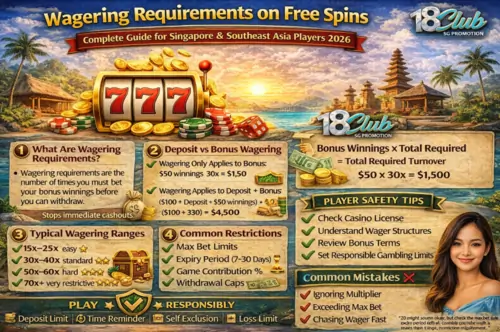
Free spins look simple: you spin, you win, you withdraw. In reality, most offers come with one key condition — wagering requirements. If you don’t understand how wagering works, you may think you’ve won money, only to realise later that you cannot withdraw yet. This guide explains what wagering requirements on free spins mean, how to calculate them, what makes them harder or easier, common traps, and what Singapore & Southeast Asia players should check.
If you are completely new to bonuses, you may want to start with our explainer on what free spins are in online casinos and our main free spins promotions page for real examples of offers.
What are wagering requirements on free spins?
Wagering requirements on free spins are the number of times you must bet your free spins winnings before you can withdraw them. For example, if you win 20 and the wagering requirement is 30x, you must place 600 in total qualifying bets before you can cash out those winnings.
To see how the underlying slot math works behind those winnings, you can also read our detailed guide on how free spins winnings are calculated, which covers paytables, RTP, volatility, and RNG.
What Is a Wagering Requirement?

A wagering requirement (also called a playthrough or turnover requirement) is a multiplier applied to your bonus balance or free spins winnings. It tells you how much total betting activity you must complete before the bonus funds become withdrawable.
Important clarification:
- It does not mean you must deposit more money.
- It means you must place bets that add up to a certain total value (required turnover).
Common models used by casinos:
- Wagering on free spins winnings only (most common for free spins).
- Wagering on bonus funds (e.g., matched deposit bonuses).
- Wagering on deposit + bonus combined (hardest to clear).
Independent guides to wagering requirements describe the same structures and stress that the “what is it applied to” line is crucial to read before you opt in.
How to Calculate Wagering Requirements on Free Spins

The core formula is straightforward:
Bonus Winnings × Wagering Multiplier = Total Required Turnover
Example 1: Winnings Only
- Free spins winnings: 40
- Wagering requirement: 25x
Calculation:
- 40 × 25 = 1,000
You must place 1,000 worth of qualifying bets before you can withdraw the 40 (and any extra profit you may earn while wagering).
Example 2: Deposit + Winnings (Much Tougher)
- Deposit: 100
- Free spin winnings: 50
- Wagering: 30x
If wagering applies to winnings only:
- 50 × 30 = 1,500
If wagering applies to deposit + winnings:
- (100 + 50) × 30 = 4,500
That’s a huge difference in required turnover. Always check whether wagering is applied to winnings, bonus, or deposit + bonus — this often decides whether an offer is realistic or nearly impossible to clear.
If you’re comparing offers that use free spins as part of a wider bundle, our guides to deposit-based free spins offers and no-deposit free spins explain how these structures differ in practice.
Typical Wagering Ranges in 2026
Looking at current industry practice:
- 15x–25x → relatively low / more player‑friendly
- 30x–40x → common “standard” range
- 50x–60x → high, difficult to clear in a normal session
- 70x+ → very restrictive; often best treated as entertainment only
Many expert guides suggest that anything above roughly 40x becomes very hard to clear profitably, especially on high‑volatility slots, and advise players to treat extremely high wagering as a fun extra rather than a serious profit opportunity.
What Makes Wagering Harder or Easier?
Several factors influence how realistic it is to complete wagering:
1. Multiplier Size
- Lower multiplier = fewer bets required = easier to clear.
- Higher multiplier = more bets required = higher risk you lose your balance before finishing.
2. Slot RTP (Return to Player)
- Higher RTP slots (for example, around 96%+) statistically return more over long periods.
- However, RTP is a long-term average; short sessions can still swing hard in either direction.
Many wagering strategy guides recommend sticking to high‑RTP slots (where allowed) because they theoretically give you more back while you turn over the requirement.
3. Volatility (Variance)
- Low volatility: smaller, more frequent wins — helps balance last longer while wagering.
- High volatility: fewer but larger wins — can either clear wagering quickly or bust you early.
If your free spins are tied to a high‑volatility slot, be prepared for bigger swings and the possibility of hitting 0 before you complete wagering, even on a fair game.
4. Game Contribution Percentage
Not all games contribute equally towards wagering. Typical structures look like:
- Slots: usually 100% contribution
- Video poker: often around 20–50%
- Table games: often 10–20%
- Live casino and some jackpots: sometimes 0% or excluded
Free spins are usually limited to specific slot games, so contribution is normally 100% — but you should always confirm which games count, especially if you plan to switch games after using the spins.
5. Maximum Bet Rule
Many casinos impose a maximum bet limit while wagering is active. For example:
- Max bet allowed: 5 per spin / game round.
If you exceed this limit even once while the bonus is active, the casino may:
- Void the bonus
- Cancel all associated winnings
This “max bet rule” is one of the most common reasons for disputes and lost bonuses; some terms explicitly say a single bet over the limit is enough to confiscate winnings, even if it was accidental. Bonus guides consistently warn players to keep bets under the stated cap until wagering is fully complete.
6. Expiry Period
Bonuses and free spins wagering usually come with a time limit, such as:
- 7 days
- 14 days
- 30 days
If you don’t complete wagering in time, the bonus and any remaining bonus‑locked winnings can be removed from your account.
Sticky vs Non‑Sticky Bonuses
Understanding this distinction helps you evaluate risk.
- Non‑sticky bonus (sometimes called “parachute” bonus):
- Your real‑money deposit and bonus are separated.
- You normally play with real money first; if you withdraw before touching the bonus, you can often cash out your real‑money balance and forfeit the bonus.
- Once you switch into bonus funds, wagering conditions apply.
- Sticky bonus:
- The bonus amount itself can never be withdrawn; only your winnings on top of it are cashable once requirements are met.
- Effective risk is higher because your bonus “principal” is locked.
Sticky structures are more common with very generous offers or complex VIP bonuses and often come with higher effective pressure to wager aggressively.
Why Casinos Use Wagering Requirements
From an operational and regulatory perspective, wagering requirements help casinos:
- Prevent bonus abuse and multi‑accounting
- Control financial exposure to “bonus hunting” strategies
- Ensure promotions are sustainable over time
- Encourage actual gameplay instead of instant cash‑out of free value
Well‑regulated casinos must describe these conditions clearly in their bonus terms and adhere to fair‑marketing standards set by their licensing authorities.
Singapore & Southeast Asia Considerations
Players in Singapore and Southeast Asia should pay particular attention to:
- Whether the casino accepts players from your country in its terms
- Which licensing authority it operates under (MGA, UKGC, PAGCOR, Curacao, etc.)
- How clearly bonus terms explain wagering, max bet, expiry, and game restrictions
- Availability of SGD or local currency deposits and withdrawals
- Transparent and realistic withdrawal rules and KYC (identity verification) procedures
Regulations differ strongly across the region, and Singapore has strict rules on unlawful remote gambling, so you should always consider both the operator’s licence and your local legal environment before depositing — even if the wagering math itself looks reasonable. Our free spins promotions page highlights offers with clearer, more player‑friendly terms where possible.
Are Wagering Requirements Fair?
Fairness depends on the entire structure, not just the multiplier. To evaluate a free spins offer, look at:
- Wagering multiplier size
- Whether it applies to winnings only, bonus only, or deposit + bonus
- Maximum withdrawal cap on free spins winnings
- Maximum bet rules while wagering
- Expiry timeframe
- Game restrictions and contribution percentages
Example:
- A 25x wagering requirement on free spins winnings with no withdrawal cap can be more player‑friendly than a 50x requirement combined with a 100 maximum cashout, even if the headline number of spins is smaller.
Our breakdowns of deposit-based free spins offers and no-deposit free spins show side‑by‑side how these factors change the real value of a promotion.
Common Mistakes Players Make
- Ignoring the Multiplier
Focusing on “100 Free Spins” but overlooking a 60x wagering requirement makes it far harder to withdraw anything meaningful. - Violating the Max Bet Rule
Placing a single bet above the allowed maximum (for example 5) can give the casino the right to cancel your bonus and winnings. - Not Checking If Deposit Is Included
Assuming wagering applies only to winnings when the terms actually say deposit + bonus can multiply required turnover by 2–3x. - Chasing Losses to Clear Faster
Increasing bet size aggressively to “finish wagering quickly” raises risk sharply and often ends in losing the entire balance. Guides that discuss “beating wagering” repeatedly stress that slow, consistent play is safer than panic‑betting.
Responsible Gambling Reminder
Clearing wagering requirements means continuous betting, which carries risk like any other gambling. Keep in mind:
- RNG ensures individual outcomes are random and cannot be predicted.
- RTP is calculated over millions of spins, not one session.
- Volatility affects short‑term swings — big ups and downs are normal, not a sign of “rigging.”
- Gambling should be treated as entertainment, not a reliable income source.
Use available responsible gambling tools where possible:
- Deposit and loss limits
- Session time reminders and reality checks
- Cooling‑off periods and self‑exclusion
If gambling starts causing stress, anxiety, or financial pressure, step back and seek help from recognised support services in your region.
Expert Insight
As an iGaming content specialist focused on transparency and regulatory awareness in Southeast Asia, I always advise players to focus on structure over spin count. The real indicators of value in any free spins offer are:
- Wagering multiplier and what it applies to
- Withdrawal cap (or lack of one)
- Maximum bet limits while wagering
- Expiry period
- Game restrictions and contribution rules
- Licensing transparency and history of fair treatment
A smaller but fair offer with clear 25x wagering on winnings, no nasty max‑bet surprises, and no harsh cap is usually more valuable than a huge headline promotion hiding 60x turnover and a low withdrawal ceiling. Our central free spins promotions overview lets you compare structures and pick offers that match your risk tolerance.
Final Summary
Wagering requirements on free spins determine how much you must bet before you can withdraw your free spins winnings. The core formula is:
Bonus Winnings × Wagering Multiplier = Required Turnover
Before you claim any free spins offer, always:
- Check the wagering multiplier
- Confirm if it applies to winnings only or deposit + bonus
- Review maximum bet rules
- Check expiry timelines
- Verify the casino’s licence and eligibility for your country
If everything is clear and reasonable, then okay lah — you can consider the offer as part of your entertainment budget, not as guaranteed profit.