

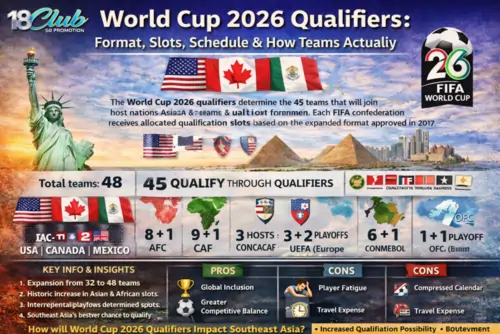
The World Cup 2026 qualifiers are the most competitive and inclusive qualification cycle in football history. The 2026 FIFA World Cup expands from 32 to 48 teams — the largest tournament ever staged — which means more qualification slots, more regional representation, and more opportunity for emerging nations. But more slots does not mean easy qualification; competition remains intense across every confederation.
If you want a quick overview of the final tournament structure, you can also read our dedicated guide to the World Cup 2026 format and our deeper breakdown of World Cup 2026 rule changes. For ongoing updates, our World Cup news hub tracks format, qualifiers, and major stories as they develop.
How Many Teams World Cup 2026 Qualifiers?
- Total teams in the final tournament: 48
- Automatic qualification: 3 hosts
- United States
- Canada
- Mexico
- Remaining places decided via qualifiers: 45 teams
As qualifiers progress, we maintain an updated World Cup 2026 qualified teams list so you can see who’s in and who’s still fighting for a spot.
Qualification Slots by Confederation (Official Allocation)
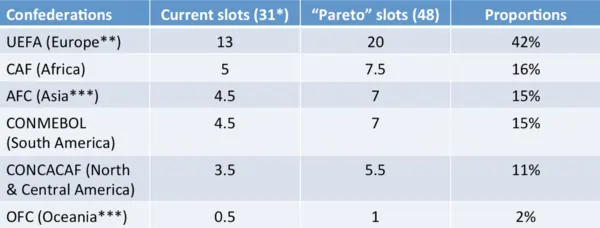
FIFA distributes 48 places across six confederations as follows:
- UEFA (Europe)
- 16 direct qualification spots
- AFC (Asia)
- 8 direct spots
- 1 intercontinental playoff spot
- CAF (Africa)
- 9 direct spots
- 1 intercontinental playoff spot
- CONMEBOL (South America)
- 6 direct spots
- 1 intercontinental playoff spot
- CONCACAF (North & Central America, Caribbean)
- 3 hosts qualify automatically (USA, Canada, Mexico)
- 3 additional direct qualification spots
- 2 intercontinental playoff spots
- OFC (Oceania)
- 1 direct spot
- 1 intercontinental playoff spot
Under the previous 32‑team format, Asia had 4.5 slots, Africa 5, and Oceania no guaranteed direct place; now Asia can reach up to 9 (8+1), Africa up to 10 (9+1), and Oceania has a guaranteed 1+1 structure. Major explainers on the 48‑team format highlight this as the most significant rebalancing of regional representation in modern World Cup history.
How the World Cup 2026 Qualifiers Actually Work
Each confederation runs its own qualification competition; there is no single global qualifying league. Regional tournaments and group stages determine who fills each confederation’s direct slots and who goes to the intercontinental playoffs.
FIFA’s official qualifiers hub provides confed‑by‑confed overviews plus fixtures and standings as matches are played.
AFC (Asia) Qualification Format Explained
Asia’s qualification system is multi‑round and also overlaps with Asian Cup qualifying:
Typical structure (simplified):
- Preliminary rounds: lower‑ranked nations play home‑and‑away ties.
- Second round: group stage combining World Cup and Asian Cup qualifying.
- Third round: higher‑level group stage with top teams.
- Final round(s): additional groups or playoffs to assign the 8 direct World Cup spots.
- Intercontinental playoff: 1 team goes into the global playoff for a possible extra place.
Because Asia now has 8 direct places plus 1 playoff, mid‑tier teams have a much stronger chance than in previous cycles. For Southeast Asia, this changes the psychology completely:
- Countries like Indonesia, Vietnam, Thailand, Malaysia, and the Philippines still face heavy competition from Japan, South Korea, Iran, Australia and others,
- But qualification is no longer “almost impossible”; it is difficult but realistic, which is a crucial shift for investment and ambition.
We’ll be following Asia’s road to 2026 and how it interacts with the overall World Cup 2026 format in our World Cup news coverage.
UEFA Qualification Structure
Europe runs group-based qualification with playoffs:
- Teams are drawn into qualification groups.
- Group winners qualify directly for the 16 UEFA slots.
- Remaining places are decided through playoff paths involving high‑performing group runners‑up and Nations League teams.
Even with 16 places, competition remains extremely intense due to the depth of European football; strong mid‑ranked teams still face tough paths to qualify. External guides on “how nations qualify for 2026” underline how much pressure remains at this level despite expansion.
CAF, CONMEBOL, CONCACAF, OFC: High‑Level Overview
- CAF (Africa): Qualifying is being played in groups (for example, nine groups of six teams), with group winners progressing and additional slots decided via further playoff mechanisms and the intercontinental playoff.
- CONMEBOL (South America): Continues with a league-style round‑robin where all teams play each other home and away, with the top 6 qualifying directly and the next team going to the intercontinental playoff.
- CONCACAF: Hosts are already in; remaining teams go through group stages and knockout rounds to award the 3 extra direct places and determine the 2 teams that go into the intercontinental playoff.
- OFC (Oceania): Runs regional qualifiers to produce 1 team that qualifies directly for the first time ever, plus another that goes to the intercontinental playoff.
Fan explainers and graphic breakdowns of each confederation’s path can be helpful to visualise how these systems all feed into the same 48‑team structure.
Intercontinental Playoffs: Final Qualification Chance
The intercontinental playoff tournament decides the final two places at World Cup 2026.
- Participants:
- 1 team from AFC
- 1 from CAF
- 1 from CONMEBOL
- 1 from OFC
- 2 from CONCACAF
These six teams play a short tournament in the host region, with seeded and unseeded positions based on FIFA rankings, to award the last two World Cup spots. This stage often produces dramatic, high‑pressure stories where a single mistake can decide an entire four‑year cycle.
Timeline of World Cup 2026 Qualifiers
- Most confederations began World Cup 2026 qualifiers in 2023.
- Qualification windows run through 2024 and 2025, with each confederation following its own calendar.
- The final qualification and intercontinental playoff matches are scheduled to conclude in late 2025.
- The World Cup itself takes place in 2026 across host cities in the USA, Canada, and Mexico.
We’ll keep updating our World Cup 2026 qualified teams list and scores & results page as nations secure their spots and as the tournament unfolds.
Historical Comparison: 32‑Team vs 48‑Team Qualification
Under the 32‑team system:
- Asia (AFC): 4.5 spots
- Africa (CAF): 5 spots
- Oceania (OFC): 0 guaranteed direct spot (0.5 via playoff)
Under the 48‑team system:
- Asia: 8 direct + 1 playoff (up to 9)
- Africa: 9 direct + 1 playoff (up to 10)
- Oceania: 1 direct + 1 playoff (first guaranteed direct place)
This is the largest structural rebalancing of global football representation in the modern era, particularly benefiting AFC, CAF, OFC and CONCACAF compared to the traditional dominance of UEFA and CONMEBOL in raw slot numbers. Our piece on World Cup 2026 prize money also touches on how expanded participation interacts with revenue distribution.
Strategic Impact on Asian & Southeast Asian Football
The expansion drives strategic changes across Asia:
- Increased government and federation investment in national teams and infrastructure.
- Youth academy development and scouting improve because a World Cup place becomes a realistic long‑term target.
- Improved domestic leagues as they’re seen as pathways to a now‑reachable international stage.
When qualification becomes statistically possible, funding and political support almost always increase. For Southeast Asia, this is not just a sporting opportunity; it is developmental leverage. Even if qualification remains challenging, having a clear, realistic pathway changes how stakeholders think, plan, and invest.
In our World Cup section, we’ll also be comparing future SEA success stories against historical greatest World Cup teams to show how far the region has come.
Is It Easier to Qualify Now?
Statistically, yes; competitively, it is still very tough.
- More slots mean a higher percentage of nations in each confederation can reach the finals.
- But top nations remain strong, and mid‑tier teams now fight each other in more intense races for the expanded spots.
Expansion increases inclusion and possibility, but performance still decides everything.
Key Challenges in the 2026 Qualification Cycle
Even with more slots, national teams and federations face significant challenges:
- Travel and logistics remain expensive for smaller federations.
- Player fatigue increases with more qualifiers and tightly packed calendars.
- Club vs country scheduling tensions continue, especially in Europe and South America.
- Competitive depth in regions like UEFA and AFC means no easy games at the top end.
Expansion does not remove competition; it simply reshapes it.
Final Analysis: Why the 2026 Qualifiers Matter
The World Cup 2026 qualifiers represent far more than just a path to the tournament. They stand for:
- Greater global inclusion and wider access to the world’s biggest football stage.
- Rebalanced regional representation, especially for Asia, Africa, Oceania, and CONCACAF.
- Increased competitive opportunity for mid‑tier and emerging nations.
- Strategic growth of football worldwide through investment, infrastructure, and youth development.
For Europe and South America, overall quality and dominance remain strong. For Asia and Africa, representation expands dramatically. For Southeast Asia, the World Cup dream feels closer than ever — still not guaranteed, but genuinely possible. And in football, the difference between “impossible” and “possible” can transform entire programmes — just as the expanded Club World Cup and bids like Brazil’s push to host the 2029 Club World Cup show how global ambitions are shifting.