

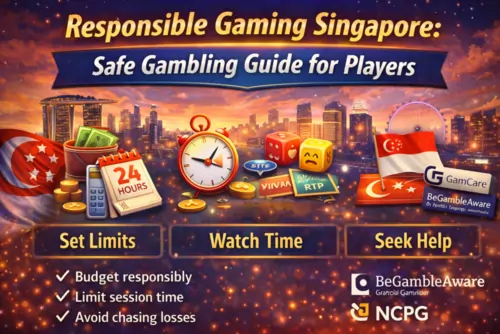
Responsible Gaming Singapore refers to structured, controlled participation in gambling activities where entertainment remains the primary purpose — not financial gain. It involves understanding risk, setting personal limits, recognizing warning signs, and using available tools to maintain balance.
For Singapore players engaging with offshore or digital platforms, responsible gaming awareness is especially important due to varying regulatory protections across jurisdictions.
This guide explains what responsible gaming means, why it matters, and how Singapore players can adopt practical safeguards.
Understanding Responsible Gaming Singapore
Responsible Gaming Singapore is built on three core principles:
- Informed Decision-Making
Players understand game mechanics, odds, RTP (Return to Player), and volatility before participating. - Personal Control
Clear time and spending limits are set before gameplay begins. - Risk Awareness
Gambling outcomes are random or probability-based — not predictable income sources.
Responsible gaming does not mean avoiding gambling entirely. It means approaching it with structure and discipline.
The Regulatory Context in Singapore
Singapore regulates gambling activities under the Gambling Control Act. Local licensed operators are subject to regulatory oversight, compliance standards, and player protection measures.
However, many online platforms accessible to Singapore players operate offshore. This may result in:
- Different consumer protection standards
- Limited dispute resolution channels
- Variable responsible gaming enforcement
This makes personal responsibility and independent platform evaluation even more critical.
Core Responsible Gaming Singapore Practices
Set a Fixed Budget
Before starting any session:
- Allocate a fixed entertainment budget
- Never exceed that amount
- Avoid using essential funds (rent, bills, savings)
Treat gambling expenses the same way you would treat spending on entertainment or leisure activities.
Set a Time Limit
Extended sessions can reduce decision clarity.
Best practice:
- Decide session length in advance
- Use alarms or reminders
- Take breaks every 30–60 minutes
Time control reduces emotional and impulsive decisions.
Understand RTP and Volatility
Responsible gaming includes understanding the mathematical framework behind games.
- RTP represents long-term return percentage
- Volatility measures payout frequency and size
Short-term results do not reflect long-term averages. Recognizing variance reduces unrealistic expectations.
Avoid Chasing Losses
Chasing losses is one of the most common high-risk behaviors.
If a session ends negatively:
- Stop immediately
- Do not increase bet size to recover losses
- Accept outcomes as part of variance
Attempting to “win back” losses often leads to further escalation.
Avoid Emotional Decision-Making
Do not play when:
- Stressed
- Angry
- Under financial pressure
- Intoxicated
Responsible gaming requires mental clarity.
Responsible Gaming Singapore Tools Offered by Platforms
Many platforms provide control features such as:
- Deposit limits
- Loss limits
- Session reminders
- Time-outs
- Self-exclusion options
- Reality checks
Singapore players should prioritize platforms that clearly display and support these tools.
If a platform does not visibly promote responsible gaming features, that may indicate lower transparency standards.
Warning Signs of Problematic Gambling
It may be time to reassess behavior if you notice:
- Spending more than planned
- Borrowing money to gamble
- Hiding gambling activity
- Neglecting work or family responsibilities
- Feeling anxious when not playing
- Repeated unsuccessful attempts to stop
Early awareness significantly reduces long-term harm.
External Support Resources
If gambling feels difficult to control, support is available.
International support resources:
For Singapore-based assistance, players can also explore:
National Council on Problem Gambling (NCPG)
Seeking support is a responsible and proactive step — not a failure.
Bonus Offers and Responsible Play
Promotions can create urgency and pressure.
Before accepting a bonus:
- Review wagering requirements
- Check expiry timelines
- Understand maximum win caps
- Evaluate whether clearance is realistic
Declining a bonus is often a safer option if terms are restrictive. check full article for Promotions.
Responsible Gaming Singapore in a Digital Environment
Online platforms increase accessibility. Because access is immediate:
- Set device-level reminders
- Avoid late-night extended sessions
- Separate gambling accounts from essential banking
Digital convenience requires stronger personal discipline.
Comparing Responsible vs. High-Risk Behavior
| Responsible Approach | High-Risk Behavior |
|---|---|
| Fixed budget | Increasing bets after losses |
| Time-limited sessions | Endless extended play |
| Entertainment mindset | Profit-driven mindset |
| Clear stop-loss | Emotional chasing |
| Reviewing platform policies | Ignoring terms |
The difference lies in structure and awareness.
Why Responsible Gaming Matters for Singapore Players
Because regulatory frameworks differ across jurisdictions, personal safeguards become your strongest protection.
Responsible gaming:
- Protects financial stability
- Reduces stress
- Improves decision quality
- Encourages long-term sustainability
- Prevents escalation patterns
It ensures entertainment remains entertainment.
Final Thoughts
Responsible gaming is not about restriction — it is about balance. Whether engaging with slot-style games, table formats, or live dealer environments, structure and awareness are essential.
Before every session:
- Set limits
- Understand the rules
- Accept variance
- Take breaks
- Stop when limits are reached
Smart gameplay begins with discipline, not impulse.