

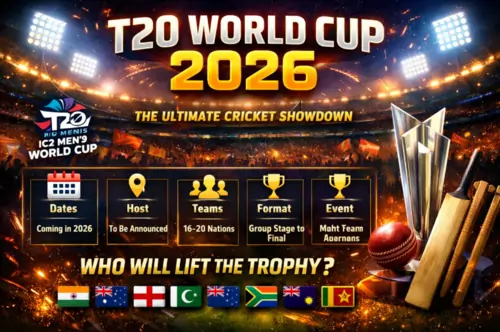
The ICC Men’s T20 World Cup 2026 is the 10th edition of cricket’s premier T20 international tournament, bringing together 20 national teams across India and Sri Lanka. With 55 fast‑paced matches in eight iconic venues, this month‑long event is designed for maximum drama, global rivalries, and huge fan engagement.
If you follow other global tournaments too, you might also enjoy our guides to the FIFA World Cup 2026 qualifiers and the FIBA Basketball World Cup 2027 in Qatar.
Quick Facts: T20 World Cup 2026
- Event: ICC Men’s T20 World Cup 2026
- Organizer: International Cricket Council (ICC)
- Format: Twenty20 internationals (20 overs per side)
- Edition: 10th ICC Men’s T20 World Cup
- Dates: 7 February – 8 March 2026
- Hosts: India & Sri Lanka (co‑hosts)
- Teams: 20 national sides
- Total Matches: 55, plus warm‑up fixtures
- Defending Champions: India
- Match Duration: Around 3 hours per game
- Frequency: Biennial (every 2 years in current cycle)
For football fans, we also break down the expanded World Cup 2026 format and key rule changes you need to know.
What Is the T20 World Cup?
The T20 World Cup is an international cricket championship where national teams compete in Twenty20 (T20) format matches, each side facing a maximum of 20 overs. T20 cricket emphasizes aggressive batting, innovative bowling, and rapid tactical shifts, making it the most commercially successful format in the sport.
In T20 internationals:
- Each team bats for up to 20 overs.
- Matches often produce high scores and tight finishes.
- Games are designed to fit into a roughly three‑hour window, ideal for TV and digital audiences.
When and Where Is T20 World Cup 2026?
Tournament dates
The ICC Men’s T20 World Cup 2026 runs from 7 February to 8 March 2026. Warm‑up matches are scheduled from 2 to 6 February, giving teams time to adapt to local pitches and conditions.
- Group stage: Early–mid February 2026.
- Super Eight: 21 February – 1 March 2026.
- Semi‑finals and final: Early March, with the title decider on 8 March 2026.
Host countries and venues
India and Sri Lanka jointly host the 2026 T20 World Cup, the first major ICC event in Sri Lanka since 2012. Matches are spread across eight venues: five in India and three in Sri Lanka.
India (5 venues)
- Narendra Modi Stadium, Ahmedabad
- Eden Gardens, Kolkata
- Wankhede Stadium, Mumbai
- M. A. Chidambaram Stadium, Chennai
- Arun Jaitley Stadium, New Delhi
Sri Lanka (3 venues)
- R. Premadasa Stadium, Colombo
- Sinhalese Sports Club (SSC), Colombo
- Pallekele International Cricket Stadium, Kandy
Ahmedabad is widely viewed as the leading candidate to host the final, with Colombo an alternate option if required by tournament logistics.
Which Teams Are Playing?
Twenty teams are taking part, combining automatic qualifiers with regional champions.
How teams qualified
- Hosts: India and Sri Lanka qualify automatically.
- Top finishers from the previous T20 World Cup and top‑ranked T20I sides gain direct entry.
- Additional spots are filled via regional qualifiers across Asia, Europe, Africa, the Americas, and East Asia‑Pacific, including debut appearances from emerging nations.
Confirmed participants include major powers and rising teams such as India, Australia, England, Pakistan, New Zealand, South Africa, Sri Lanka, West Indies, Afghanistan, Bangladesh, Ireland, Netherlands, Namibia, Nepal, and Italy, among others.
If you’re also tracking who has made it to the 48‑team football showpiece, see our updated World Cup 2026 qualified teams list.
Tournament Format Explained
The 2026 tournament uses a three‑phase structure: group stage, Super Eight, then knockouts.
- Group Stage
- 20 teams divided into four groups of five.
- Each team plays the other four teams in its group once (single round‑robin).
- Top two teams from each group (eight total) advance to the Super Eight.
- Super Eight Stage
- Eight qualifiers split into two groups of four under a preset seeding system.
- Each team plays three matches, one against every team in its Super Eight group.
- Top two from each Super Eight group reach the semi‑finals.
- Knockout Stage
- Semi‑finals: Group winners face runners‑up from the opposite Super Eight group.
- Final: Semi‑final winners meet on 8 March 2026 to decide the champion.
Because a single over can swing the game, the format rewards composure under pressure, tactical flexibility, and strong death‑overs skills.
For a football comparison, you can see how a larger 48‑team tournament works in our analysis of the World Cup 2026 format.
Why T20 World Cup 2026 Matters Globally
The 2026 edition is more than a sports event; it is a major economic and cultural moment for India, Sri Lanka, and the wider cricket world.
It drives:
- Global broadcast and streaming revenues across TV, OTT, and digital platforms.
- Tourism and local economic activity in host cities, spanning hospitality, travel, and events.
- Sponsorship growth for brands targeting young, mobile‑first sports audiences.
- Development pathways for associate nations, especially debutants and returning qualifiers.
T20 remains the format most closely linked to franchise leagues, short‑form digital content, and youth engagement, ensuring strong crossover between international cricket and domestic T20 ecosystems.
If you enjoy long‑view football history, you can also explore our feature on the greatest World Cup teams of all time.
Players and Roles to Watch
By 2026, established stars share the stage with new talents rising from franchise leagues and high‑performance programs. While individual squads evolve, the key roles that shape matches are consistent:
- Powerplay specialists who maximize the first six overs with bat or ball.
- Death‑over finishers capable of striking at 150+ and closing out chases.
- High‑pace fast bowlers operating at 145 km/h and above.
- Mystery spinners and variations specialists who disrupt rhythm on slower pitches.
- All‑rounders who balance line‑ups and allow teams to deepen both batting and bowling.
T20 rewards adaptability; teams that read conditions quickly, rotate strike efficiently, and control pressure moments often advance deep into the tournament.
How to Watch T20 World Cup 2026
Fans worldwide can follow the tournament through:
- Official ICC broadcast partners (regional TV rights holders).
- Licensed streaming platforms in each territory.
- National sports broadcasters covering their home teams’ matches.
- ICC and tournament digital platforms for scores, clips, and highlights.
Broadcast rights vary by country, so viewers should always use authorized providers for legal access, reliable streams, and high‑quality coverage.
For football score‑hunters, we also maintain a live‑updated hub for FIFA World Cup 2026 scores across all groups and knockout rounds.
What to Expect in 2026
Analytical tools, match‑ups data, and ball‑by‑ball insights will shape team tactics more than ever in 2026. Expect higher average scores, deeper batting line‑ups, and increasingly specialized bowling plans, especially in powerplay and death overs.
By 2026, the T20 World Cup showcases:
- Greater use of performance analytics and match‑ups in selection and in‑game decisions.
- Expanded global broadcast reach and second‑screen experiences for fans.
- Increased competitive depth from associate nations, including debutants such as Italy.
- Rapid improvements in fielding standards, athleticism, and boundary‑saving techniques.
If you follow multi‑year tournament cycles, you may also be interested in long‑term projects like Brazil’s bid for the 2029 Club World Cup, which shows how nations position themselves for future hosting rights.
The 2026 edition captures the modern, data‑driven evolution of T20 cricket — fast, strategic, and built for a global, digital‑first audience.