

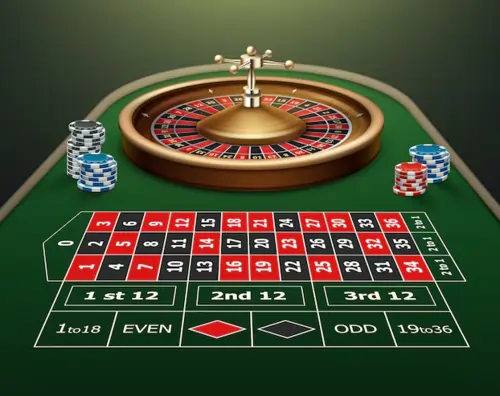
Casino table games are gambling games played on a physical or virtual table, usually managed by a dealer, where players use cards, dice, or a spinning wheel to place bets and win payouts based on specific rules. Unlike slot machines, table games often involve strategy, probability awareness, and structured betting options. Common examples include Blackjack, Baccarat, Roulette, Poker, and Craps. These games are available in both land-based casinos and licensed online casinos, including live dealer formats.
Casino table games are structured gambling games played on a table with a dealer, using cards, dice, or a wheel. Players place bets according to the rules of each game, and payouts are made based on fixed odds or probability-driven outcomes.
How Casino Table Games Work
Although each table game has its own specific rules, most follow this general process:
- Players place their bets on the table layout.
- The dealer initiates the round (deals cards, spins the wheel, or rolls the dice).
- The game outcome is determined according to the rules.
- Winning bets are paid according to the payout table.
- A new round begins and players may adjust or place new bets.
In online casinos, table games usually come in two formats:
- RNG Table Games
- Outcomes are generated using certified Random Number Generator (RNG) software.
- Results are algorithmic, but audited for fairness by regulators or testing labs.
- Live Dealer Table Games
- A real human dealer hosts the game from a studio or casino floor via live video stream.
- Players place bets on a digital interface while watching the dealer in real time.
- This format simulates a real casino environment and offers higher transparency and social interaction.
- Live dealer games are especially popular in Southeast Asia, where many players value real-time dealing and visible results.
Main Types of Casino Table Games
1. Blackjack
Blackjack is a card game where players aim to reach a hand total of 21, or as close as possible, without going over.
- Played against the dealer, not against other players.
- Involves mathematical strategy, including decisions like hit, stand, double down, and split.
- Under standard rules and with basic strategy, blackjack can offer one of the lowest house edges, often around 0.5% or better.
- Because player decisions significantly affect results, blackjack is considered a semi-skill game rather than pure chance.
2. Baccarat
Baccarat is extremely popular across Asian markets, including Singapore and Macau.
- Players typically bet on one of three outcomes:
- Player hand
- Banker hand
- Tie
- The Banker bet usually has the lowest house edge (around 1.06% under standard rules).
- Gameplay is simple and fast, with decisions mostly limited to choosing which side to bet on.
- Because players have few decisions to make, baccarat is largely chance-based and very beginner-friendly.
3. Roulette
Roulette uses a spinning wheel with numbered pockets and a small ball.
- Players can place a variety of bets on:
- Individual numbers
- Red or Black
- Odd or Even
- Dozens and number ranges
- European Roulette (single zero) has a lower house edge (about 2.7%) than American Roulette (double zero), which has a house edge of around 5.26%.
- The variety of bet types allows both low-risk and high-risk betting styles within the same game.
4. Poker (Casino Table Variants)
Poker differs from most table games because players typically compete against each other rather than against the house.
- Key skill factors include probability calculation, hand reading, bluffing, and psychological strategy.
- Texas Hold’em is the most widely played poker variant worldwide.
- In casino cash games and tournaments, the house usually earns money via a “rake” or tournament fees, not directly through a house edge on each hand.
- Some casino table poker variants (e.g., Casino Hold’em, Caribbean Stud) put players against the house and have defined house edges.
5. Craps
Craps is a fast-paced dice-based table game.
- Players bet on the outcome of one or more rolls of two dice.
- The game offers many different betting options, some simple and others more advanced.
- It can feel complex for beginners due to the number of bets and table markings, but basic bets like Pass Line and Don’t Pass are straightforward.
- Once understood, craps offers several bets with very competitive house edges compared to many other casino games.
Casino Table Games vs Slot Machines
Players often compare table games and slot machines to decide which suits their style and risk tolerance.
Key Differences
| Feature | Table games | Slot games |
|---|---|---|
| Skill element | Present in some games (e.g., Blackjack, Poker) | None; outcomes are purely RNG-based |
| Interaction | High, with dealer and sometimes other players | Low; mostly solitary play |
| House edge | Often lower, varies by game and rules | Usually higher on average, varies by title and provider |
| Game pace | Structured rounds, pauses between decisions | Continuous spins, often fast-paced |
| Transparency | Rules-based and visibly resolved outcomes | Algorithm-based; fairness depends on certified RNGs |
Players who prefer strategic involvement and social interaction often gravitate toward table games, while those seeking simple, fast, and visually engaging play may prefer slots.
House Edge and RTP Explained
Understanding house edge and RTP helps players make more informed decisions before playing.
- House Edge: The casino’s built-in mathematical advantage over the long term, expressed as a percentage of each bet.
- RTP (Return to Player): The opposite perspective, showing the percentage of wagered money a game is expected to pay back to players over a large number of bets.
Example RTPs under standard rules and optimal play:
- Blackjack RTP: around 99.5% with basic strategy (house edge ~0.5%).
- Baccarat (Banker bet) RTP: around 98.94% (house edge ~1.06%).
- European Roulette RTP: about 97.3% (house edge ~2.7%).
Lower house edge generally means better long-term value for the player, but it does not guarantee short-term wins. All casino games are designed so that, over time, the house maintains an overall advantage.
Are Casino Table Games Legal in Singapore?

In Singapore, gambling is tightly regulated, and only specific operators and products are legal.
- Land-based casinos are legal at Marina Bay Sands and Resorts World Sentosa, both operating under strict regulation and licensing.
- Online and remote gambling are governed by the Gambling Control Act 2022 and overseen by the Gambling Regulatory Authority (GRA).
- Singapore Pools is the only legal remote gambling operator for approved products, such as certain lottery and sports betting offerings, not general public-facing online casino table games.
- Private, unlicensed, or offshore online casino platforms targeting Singapore residents are generally illegal and may pose serious legal and consumer protection risks.
- Players should always verify the licensing status and jurisdiction of any operator before depositing funds.
If you are in Singapore or Southeast Asia, it is essential to understand local laws and only use operators that are properly licensed in your jurisdiction.
Why Table Games Are Popular in Southeast Asia
Several cultural and practical factors drive the popularity of casino table games in Southeast Asia:
- Strong baccarat culture in many Asian markets, where baccarat is often seen as the primary high-stakes game.
- Preference for live dealer formats, which combine digital convenience with real-time dealing and human interaction.
- Long-standing social gambling traditions, where groups of friends or families enjoy playing together.
- Perception that table games offer better odds and more control compared to slots, especially in games like blackjack and certain craps bets.
- In regulated markets, licensed operators emphasize transparency and responsible gambling tools, such as limits, self-exclusion, and clear information about odds.
Responsible Gambling Reminder
Casino table games should always be treated as entertainment, not as a way to make money.
They are not:
- Investment tools
- Reliable income sources
- Solutions for financial problems
Before playing:
- Set a clear budget you can afford to lose and stick to it.
- Set time limits and take regular breaks.
- Avoid chasing losses, increasing bets just to “win it back.”
- Do not gamble when under emotional stress, anger, or intoxication.
- If gambling stops feeling enjoyable and starts to feel like pressure or compulsion, it is time to stop.
Licensed platforms should provide access to responsible gambling resources, including self-exclusion options, deposit limits, and links to professional support services. Always prioritize your financial and mental well-being over any potential winnings.
Final Thoughts
Casino table games combine probability, structure, and entertainment, ranging from purely chance-based games to those that reward skill and strategy. For players in Singapore and across Southeast Asia, understanding regulation, licensing, house edge, and responsible gambling practices is essential before participating. In regulated markets, transparency, compliance, and robust player protection measures are key signs of a trustworthy operator. Always play responsibly, within your financial limits, and view casino games as a form of paid entertainment rather than a source of income.