

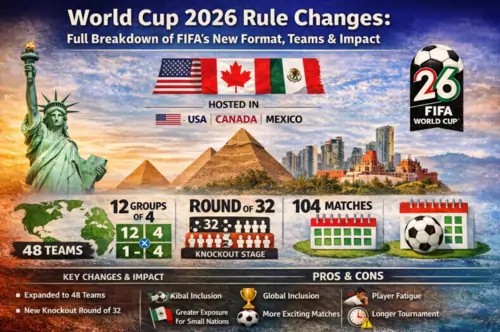
The World Cup 2026 rule changes represent the biggest structural transformation in FIFA tournament history. For the first time ever:
- 48 teams will compete (up from 32)
- 104 matches will be played (up from 64)
- A new 12‑group format will be used
- Three countries will co‑host the tournament: USA, Canada, and Mexico
If you’re wondering how this affects qualification chances, competition fairness, player fatigue, or smaller nations, this guide breaks it down in clear language. For ongoing tournament‑style coverage and analysis, you can also follow our football features on 18Club SG Promotions. For official updates on format, host cities, and key dates, FIFA’s World Cup 2026 hub is a useful reference.
World Cup 2026 rule changes refer to FIFA’s expansion from 32 to 48 teams, the introduction of 12 groups of four teams, a new Round of 32 knockout stage, and an increase to 104 total matches, hosted across the United States, Canada, and Mexico.
If you want a simple visual breakdown of the groups, venues, and calendar, FIFA’s official match schedule and stadium page provides an updated overview.
Why Did FIFA Change the World Cup Format?
FIFA officially approved the expansion to 48 teams and a revised format to:
- Increase global participation and representation
- Boost commercial and broadcast revenue
- Develop football in emerging regions
- Strengthen slots for Asia, Africa, and CONCACAF
Football is no longer dominated only by Europe and South America; growth in Asia, Africa, and North America is accelerating. From FIFA’s combined sporting and business perspective, this expansion is a strategic move that fits its long‑term globalization plan.
Major World Cup 2026 Rule Changes Explained
1. Expansion to 48 Teams
Previous format:
- 32 teams (from 1998 to 2022)
New format (from 2026):
- 48 teams
- 16 more national teams than before
Confederation slot allocation (direct slots):
- AFC (Asia): 8 direct slots
- CAF (Africa): 9 direct slots
- CONCACAF: 6 direct slots
- CONMEBOL (South America): 6 direct slots
- OFC (Oceania): 1 direct slot
- UEFA (Europe): 16 direct slots
Hosts automatically qualify, and their places are taken from their confederation’s quota. FIFA’s own allocation release details this distribution for each confederation.
For Asia and especially Southeast Asia, this is huge. With AFC now on 8 direct places (plus playoff pathways), countries like Indonesia, Thailand, Vietnam, and Malaysia have a far more realistic path to qualification than under the old 4.5‑slot system.
2. New Group Stage Structure
FIFA initially proposed 16 groups of three teams, but there were major concerns about possible match manipulation in final group games.
Revised and confirmed format:
- 12 groups of 4 teams
- Top 2 teams from each group qualify (24 teams)
- Best 8 third‑placed teams also qualify
- 32 teams move into the knockout phase
This keeps the familiar four‑team group feel, reduces the risk of “arranged draws”, and guarantees every team at least three matches. For a fan‑friendly explanation of how the 12‑group format and Round of 32 work in practice, this World Cup 2026 format explainer complement.
3. Introduction of a Round of 32
Because 48 teams now reach the finals instead of 32, the knockout structure changes to:
- Round of 32
- Round of 16
- Quarterfinals
- Semifinals
- Final
For fans, this means more high‑stakes knockout matches and more drama. For players, it means that teams reaching the semifinals and final can now play up to eight matches instead of seven, pushing physical demands even higher.
4. Increase to 104 Total Matches
World Cup 2022:
- 64 matches over 29 days
World Cup 2026:
- 104 matches over a longer window (around 39 days)
That’s a 62.5% increase in matches at the tournament itself.
Impact on players and schedule:
- Higher fatigue risk for players reaching deep stages
- More pressure on crowded club calendars and international windows
- Greater need for smart squad rotation and load management
FIFA notes that the combined “release + rest + tournament” window remains about 56 days, similar to previous editions, but critics argue the extra game and travel still push players close to their limits.
5. Three Host Nations
World Cup 2026 will be co‑hosted by:
- United States
- Canada
- Mexico
This is the first tri‑nation World Cup in history.
Advantages:
- Large, modern stadiums
- Strong transport and event infrastructure
- Huge commercial market, especially in the USA
Challenges:
- Long travel distances between some host cities
- Time zone differences across North America
- Different climates and altitudes
Logistically, it’s complex, but commercially, it strongly supports FIFA’s long‑term North American football strategy. Fans planning travel can also check host‑city‑specific sites like the NY/NJ or Los Angeles World Cup 26 pages for stadium and local information.
6. Squad Size & Substitution Rules
Recent tournaments have already moved away from 23‑man squads:
- Qatar 2022 used 26‑player squads.
- Five substitutions per match are now standard under the Laws of the Game.
Heading into 2026:
- 26‑player squads are expected to continue as the norm.
- Five substitutions per match (plus an extra in extra time) are set to remain in place.
This helps coaches manage fatigue and injuries within a longer tournament and heavy travel demands.
Old vs New: Format at a Glance
| Area | Old format (1998–2022) | 2026 format |
|---|---|---|
| Teams | 32 | 48 |
| Groups | 8 groups of 4 | 12 groups of 4 |
| Total matches | 64 | 104 |
| Knockout start | Round of 16 | Round of 32 |
| Max games/team | 7 (if reaching the final) | 8 (if reaching the final) |
| Hosts | Usually 1 country | 3 countries (USA, Canada, Mexico) |
Strategic Impact of World Cup 2026 Rule Changes
1. Competitive Balance
More teams mean:
- Wider global representation
- Possible skill gap between elite and lower‑ranked teams
- Higher chance of surprise results and “Cinderella” runs
Some argue the quality of early group‑stage matches may drop, while others note that previous expansions also produced new stories and upsets, with Morocco’s 2022 semi‑final run as a recent example of an emerging power reshaping expectations.
2. Financial & Commercial Growth
World Cup 2026 is projected to generate record‑breaking revenue from:
- Global broadcasting and digital rights
- Sponsorship and brand partnerships
- Tourism spend across North American host cities
- Long‑term growth of football in the U.S. and Canada
The United States is one of the world’s largest sports markets, and FIFA clearly sees this edition as a foundation for stronger commercial and participation growth in the region.
3. Impact on Asian & Southeast Asian Football
For Asia, the slot expansion is a game‑changer:
- AFC now has 8 direct slots plus extra playoff access, up from 4.5 under the old system.
- More available places can unlock increased government support, federation funding, and private investment in football infrastructure.
- Qualification campaigns become more competitive and meaningful for mid‑tier teams.
Established powers like Japan and South Korea benefit from more breathing room, while Southeast Asian nations (Vietnam, Thailand, Indonesia, Malaysia, etc.) now see a clearer pathway to a first‑ever World Cup appearance.
On 18Club SG Promotions, we’ll be following how Asian and Southeast Asian teams adapt to this new landscape, with a focus on qualification pathways and key fixtures for regional fans.
Pros and Cons of the New Format
Pros
- Greater global inclusion and representation
- More matches and content for fans and broadcasters
- Higher revenue that can be reinvested into development
- Increased visibility and experience for smaller nations
- Stronger global narrative around football as a truly worldwide game
Cons
- Higher risk of player fatigue and injuries
- Longer tournament duration with more travel
- Potential early‑stage quality gap between top and lower‑ranked teams
- Added pressure on already congested club and international calendars
A balanced view recognises that the expansion opens doors for many countries but also demands smarter scheduling, player‑welfare measures, and ongoing format review.
Final Analysis: Is the Expansion Good or Risky?
The World Cup 2026 rule changes bring both opportunity and risk.
Opportunities:
- Football becomes more inclusive, with more regions represented.
- Emerging nations gain visibility, experience, and investment.
- Fans enjoy more matches, more storylines, and a larger global event.
Risks:
- Player workload increases, especially for top players balancing club and country.
- The tournament becomes longer and more logistically complex.
- Maintaining competitive balance and match quality in early stages is a real challenge.
From a long‑term strategic perspective, the expansion fits FIFA’s globalization and revenue‑growth strategy. Whether fans fully embrace the new era will only become clear once the ball starts rolling in 2026, but one thing is certain: World Cup 2026 will be the biggest World Cup ever staged, in both scale and global reach.