

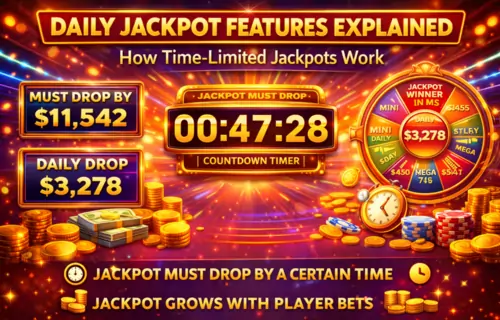
Daily jackpot features slots add a time‑based twist to classic jackpots. Instead of growing indefinitely until someone hits them, these jackpots are designed to drop within a specific time window, usually once every 24 hours. That mix of a growing prize and a visible deadline is what makes daily jackpots feel more active and exciting than many standard progressives.
In this guide, you’ll learn how daily jackpots work, how they differ from fixed and regular progressive jackpots, what to watch for in the rules, and how to play them responsibly. For broader context, you can also see our guides on progressive jackpots, how jackpot pools grow, mega jackpot slot mechanics, and fixed vs progressive jackpots.
What Is a Daily Jackpot?
A daily jackpot is a time‑limited progressive jackpot that is designed to pay out at least once within a defined period—most commonly once per day. When the jackpot is hit, it resets to a starting value (seed) and begins growing again for the next period.
You can think of daily jackpots as a middle ground between:
- Standard progressive jackpots (which can run for weeks or months).
- Fixed jackpot slots (which never change in size).
For a full comparison of those two formats on our site, see fixed jackpot vs progressive jackpot.
“Daily” vs “Daily‑Themed”
Not every jackpot labelled “daily” works in exactly the same way. Some networks:
- Truly guarantee a drop within a 24‑hour window (“must drop by” a specific time), like the Daily Drop Jackpots networks many casinos promote.
- Others use “daily”, “must drop”, or similar branding for a “must drop before” amount jackpot that usually, but not always, pays within a day.
Always check the game’s info screen or the network description—guides such as this must drop slots explainer and must hit by slots guide show why this matters—to see whether:
- The jackpot is genuinely guaranteed to drop daily, or
- It is a “must hit by” style pot that has a trigger range rather than a strict daily schedule.
How Daily Jackpot Features Work
Daily jackpots sit on top of a standard slot game. The provider or network sets:
- The contribution rate (what % of each bet goes to the jackpot).
- The seed value (starting amount after each win).
- The drop logic (time‑based, amount‑based, or a mix).
For a deeper look at contribution logic and pool growth, see our guide on how jackpot pools grow and general jackpot slots guides.
Contribution to the Jackpot Pool
Every qualifying spin contributes a small part of the bet to the daily jackpot pool.
Typically:
- A fixed percentage of each wager is allocated to the jackpot.
- The prize pot grows across all linked games or casinos in real time.
- The rest of your stake goes into the normal slot maths for reels, line wins, and features, as explained in RNG, RTP and fair play overviews.
Trigger Conditions
Common daily‑jackpot configurations include:
- Time‑limited “must drop by”
- The jackpot is guaranteed to drop before a specific cut‑off (for example, before 23:59).
- Games show a visible countdown or “must drop by” time, similar to setups described in Daily Drop Jackpot overviews.
- Hidden value range (“must drop before” amount)
- Hybrid time and value logic
- The jackpot must drop either before a maximum hidden amount or by a fixed time, whichever comes first.
From the player’s perspective, it looks like:
- The jackpot can drop at any time,
- But it is forced to drop by a certain time or “must‑hit‑by” value.
Daily vs Regular Progressive vs Fixed Jackpots

Daily Jackpot vs Regular Progressive
- Regular progressive jackpot
- Grows for as long as it is not hit.
- No fixed time limit; some pots run for weeks or months.
- Top prizes can become very large but are extremely rare and unpredictable.
- Daily jackpot
- Grows like a normal progressive but must drop within a defined window or trigger range.
- Drops much more frequently by design.
- Usually offers smaller top prizes than the biggest network progressives, but they feel more attainable due to the time constraint.
For a full overview of progressive systems, see our guide to progressive jackpots, our deep dive into mega jackpot slot mechanics, and an external progressive jackpot slots guide.
Daily Jackpot vs Fixed Jackpot
- Fixed jackpot
- Daily jackpot
- Top prize grows over time and is then forced to drop by a certain point.
- Adds both a growth element and a time‑pressure element.
For a detailed comparison of prize size, volatility, and RTP between fixed and progressive formats, see fixed jackpot vs progressive jackpot and this external overview of fixed vs progressive jackpots.
Common Types of Time‑Based Jackpots
Many daily jackpot networks offer several tiers at once:
- Hourly / “Quick Drop” Jackpot
- Smaller prize that must drop within a short period (e.g., every hour).
- Very frequent, usually lower‑to‑mid‑range wins.
- Daily / “Daily Drop” / “Must Drop Today”
- Medium‑sized jackpot that must drop within 24 hours (or similar).
- The core feature of most Daily Drop jackpot networks.
- Super / Mega / Long‑Term Jackpot
- Larger progressive with no daily deadline.
- Less frequent but higher‑value top prize, similar to classic jackpot structures in general jackpot slot guides.
This structure lets you choose between:
- Smaller, more frequent time‑limited jackpots (hourly/daily), and
- Bigger, long‑term jackpots, often on the same set of games.
How Daily Jackpots Are Displayed
Daily jackpot games and lobbies usually highlight three key elements:
- Current jackpot amount
- Shown prominently, often above the reels or in a network bar.
- Updated in real time across all participating games.
- Countdown or “must pay by” message
- A visible timer or text like “must drop by 23:59”.
- Drives the feeling of urgency and reinforces that the pot is time‑limited.
- Jackpot tier labels
- Terms like “Hourly”, “Daily”, “Mega”, “Must Drop”, “Super”, etc.
- Indicate approximate prize scale and frequency.
These visual cues are central to the appeal: you immediately see how big the jackpot is and how long is left before it has to drop.
RTP, Volatility and Value in Daily Jackpot Slots
Daily jackpot slots follow the same basic metrics as other slots—RTP and volatility—but shift more of their long‑term return into less‑frequent jackpot events.
RTP (Return to Player)
RTP is the theoretical percentage of total bets that a slot returns to players over a very large number of spins. For a clear primer, see this guide on what RTP and volatility mean in slots.
For daily jackpot slots:
- A portion of each bet funds the daily (and often hourly/mega) jackpots.
- That contribution is part of the overall RTP, not an extra bonus on top.
- Because some of the RTP is reserved for jackpot hits, the base‑game RTP is often slightly lower than similar non‑jackpot games.
In practice:
- Many standard online slots cluster around 96% RTP, depending on provider and jurisdiction.
- Daily‑jackpot products can be a bit lower overall (for example, 94–95%), because they allocate extra return to those hourly/daily/mega pots.
If you care about long‑term value, both our internal content and external resources like this RTP decoded guide suggest:
- Check the published RTP where available.
- Remember that part of the return is “locked” in rare jackpot events; you only see that value if those jackpots are hit during your play.
Volatility
Daily jackpot games are typically medium to high volatility:
- The base game may be a little tighter than a non‑jackpot equivalent to make room for the jackpot contribution.
- Jackpot hits (especially daily or mega tiers) deliver large, infrequent spikes in payout.
You can expect:
- Stretches where you see regular line wins and features but no jackpot.
- Occasional sessions where a daily or hourly pot drops and dramatically changes your result (for you or someone else on the network).
For more on how volatility affects slot behaviour, see this explanation of slot volatility.
“Easier Near the Deadline”? What Players Get Wrong
A common belief is that daily jackpots are “easy money” when the countdown is close to zero. Guides to must drop jackpots and must hit by slots highlight why this is misleading:
- At the network level:
- The jackpot must drop before the end of the defined window or before a “must‑hit‑by” value, so the closer you get, the more likely it becomes that someone will hit it soon.
- At the individual player level:
Treat the countdown as an extra layer of excitement, not as a guarantee that you can force a win by playing more aggressively as the timer runs down.
Practical Tips for Playing Daily Jackpot Slots
You cannot beat the built‑in house edge, but you can control how you interact with daily jackpots.
- Read the rules and info panel
- Confirm whether the jackpot is truly daily or “must drop before” a certain amount.
- Check any minimum bet requirements for hourly or daily tiers.
- See which jackpots your current stake actually qualifies for.
- Set a session budget
- Decide how much you are comfortable losing before you start.
- Treat this as a strict entertainment budget, not money you must win back.
- Use modest stakes
- Choose a bet size that allows for a reasonable number of spins given the higher volatility.
- Smaller stakes can help smooth out swings and avoid pressure.
- Don’t chase the countdown
- Avoid extending sessions or increasing stakes just because the timer is close to zero.
- Another player can trigger the jackpot at any moment, and a new cycle will start.
- Treat daily jackpots as a side feature
- Consider daily jackpot networks as a small, high‑variance part of your overall slot play.
- Use higher‑RTP or less volatile games as your main volume, and allocate a limited portion of your bankroll to daily jackpots for extra excitement.
For more on choosing between jackpot types, see fixed jackpots vs progressive jackpots and external comparisons like daily vs progressive jackpots.
Responsible Gambling and Daily Jackpots
Daily jackpots are designed to be engaging: the combination of a visible countdown, rising prize, and marketing around “must drop” can encourage longer or more intense play if you’re not careful.
To keep things safe:
- Set clear limits on time and money
- Decide in advance how long you’ll play and how much you can afford to lose.
- Stop when you reach either limit, even if the jackpot is still running.
- Watch for red‑flag behaviour
- Playing much longer than planned “because it might drop soon”.
- Increasing stakes after losses to “take advantage” of the countdown.
- Feeling irritated or anxious when you can’t keep playing.
- Use built‑in tools
- Many reputable operators and regulators highlight tools such as deposit limits, loss limits, time reminders, and self‑exclusion in their responsible gambling guides.
- Industry resources like the American Gaming Association’s responsible gaming regulations guide and general responsible gambling manuals show why these tools matter.
- Treat jackpots as entertainment, not income
- Never gamble with money needed for bills, debts, or essentials.
- Consider any jackpot win a bonus, not part of your financial planning.
- Seek help if needed
- If gambling starts to affect your finances, mood, or relationships, or you find it hard to stick to limits, consider contacting a recognised safer‑gambling organisation or helpline in your region.
For a broader overview of responsible play and how safer‑gambling messaging is evolving, reviews such as this safer gambling messaging research are worth a look.