

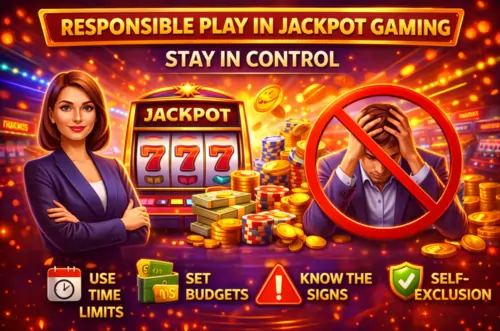
Jackpot games—fixed, progressive, mega, and daily—combine high volatility, emotional swings, and the lure of big wins. That mix makes them exciting but also risky if you don’t set clear limits. Responsible play means treating jackpot gaming as paid entertainment, not a way to solve money problems or guarantee profit.
If you want to understand the mechanics behind different jackpot formats before diving in, see our guides to progressive jackpots, how jackpot pools grow, mega jackpot slot mechanics, fixed vs progressive jackpots, daily jackpot features, and our overview of jackpot games.
Why Responsible Play in Jackpot Gaming
Jackpot slots are built around rare, high‑impact wins funded by many losing or small‑win spins. This structure creates:
- Strong emotional swings (big wins, long losing streaks, near‑misses).
- A powerful urge to chase losses or “stay until the jackpot drops”.
- A real risk of overspending and time loss if you don’t manage your play.
Research and fact sheets on gambling harm highlight that high‑risk products like jackpot slots can contribute to financial, emotional, and relationship problems when used without limits.
Key mindset: Jackpots are entertainment with a cost, not a reliable path to profit.
Understanding the Risk Side of Jackpot Gaming

1. Volatility and Long Losing Streaks
Jackpot games—especially progressive, mega, and some daily jackpots—are usually high‑volatility:
- Wins are less frequent, but can be larger when they do appear.
- It’s normal to hit long losing streaks, even if the RTP is fair over the long run.
Guides on slot volatility and slot strategies explain that high‑volatility games require smaller stakes and stronger bankroll discipline.
Practical takeaway:
Use smaller bet sizes on jackpot games than you would on low‑volatility slots, and expect longer sequences with no big wins.
2. House Edge, RTP and Jackpot Contributions
All jackpot games have a house edge; the casino always has a long‑term advantage.
- RTP (Return to Player): Theoretical percentage of total bets returned to all players over a huge number of spins.
- Many jackpot games reserve part of their RTP to fund the jackpot pool, which is only paid out when someone hits it.
- This often means jackpot games have slightly lower overall RTP than comparable non‑jackpot slots.
For a deeper look, see educational pieces on RTP and volatility in slots and RTP decoded.
Practical takeaway:
You’re paying extra for a small chance at a large prize. That’s fine for fun, but it’s not a value‑maximising strategy.
3. Psychological Traps and Cognitive Biases
Jackpot games are designed to be thrilling:
- Near‑misses and almost‑wins can make you feel like you’re “close”.
- Large jackpot meters and “must drop” timers create urgency and FOMO.
- Myths like “the machine is due” or “I’m on a hot streak” can push you to keep playing, even when it’s not wise.
Responsible gambling resources stress that outcomes remain random and independent, no matter how “due” a jackpot feels.
Practical takeaway:
Recognise that these games exploit normal human biases, and build rules that protect you from acting purely on emotion.
Setting Healthy Limits for Jackpot Play
1. Bankroll Limits (Money Management)
Before you open any jackpot game:
- Decide how much you can comfortably afford to lose today—an amount that won’t affect bills, savings, or essentials.
- Treat that amount as a fixed entertainment budget, not money you must win back.
Good practices suggested by responsible gambling guides:
- Use a separate e‑wallet or card for gambling so you can see your total spend clearly.
- Avoid “quick deposit” top‑ups once your session budget is gone.
- Don’t increase your budget mid‑session because “the jackpot looks close.”
2. Time Limits
Jackpot slots are fast and immersive. To avoid losing track of time:
- Set a clear session length (for example, 30–60 minutes).
- Use alarms or in‑site “reality checks” where available.
- Take short breaks at regular intervals to reset.
Responsible gambling checklists emphasise that controlling session length is one of the simplest ways to prevent binge play.
3. Bet Size and Game Mix
To keep variance manageable:
- Choose modest stakes that allow plenty of spins within your budget.
- Avoid increasing your stake after a losing streak—this is classic chasing behaviour.
- Use higher‑RTP, lower‑volatility slots for most of your play, and reserve jackpot games for a small percentage of your bankroll.
You can use our jackpot games page as a starting point to mix different jackpot types with more stable titles.
Safer Strategies by Jackpot Type
For technical details on each jackpot type, see our guides on progressive jackpots, mega jackpot mechanics, fixed vs progressive jackpots, and daily jackpot features.
Fixed Jackpots
- Clear, fixed top prize.
- Typically more predictable than huge network progressives.
Play responsibly by:
- Treating them like normal slots—focus on enjoyment, not just the top win.
- Not increasing stakes solely because the fixed jackpot “looks achievable.”
Progressive and Mega Jackpots
- Offer very large potential prizes but extremely low odds for the top tier.
- Often have lower base‑game RTP and higher volatility.
Safer approach:
- Allocate only a small, pre‑defined portion of your budget to progressives and mega jackpots.
- Assume you will not hit the top prize; enjoy base‑game features and smaller wins instead.
- Avoid the mindset that a large jackpot is “too good to miss” or that you must play because it might go soon.
Daily / Must‑Drop Jackpots
- Time‑limited jackpots that must drop within a certain window (e.g., daily).
- The countdown can create strong urgency and encourage extended play.
Safe habits:
- Ignore the timer if you’re near your money or time limit; your limits matter more than the countdown.
- Don’t extend sessions or raise stakes “because the jackpot must drop soon.”
- Treat daily jackpots as a bonus side feature, not your core play.
Emotional Control and “Stop Signals”
Recognise Red Flags
Evidence reviews of gambling harm highlight common warning signs:
- Playing longer or spending more than planned “because of the jackpot”.
- Feeling stressed, angry, or desperate while playing.
- Hiding or lying about gambling to others.
- Gambling to escape financial, emotional, or work problems.
If you notice these, it’s a sign you may need to pull back or seek support.
Pre‑Set Stop Rules
Before you start, write down simple rules such as:
- “If I lose my session budget, I stop—no exceptions.”
- “If I feel angry, stressed, or tempted to chase, I immediately log out.”
- “If I’ve played for an hour, I end the session, win or lose.”
Responsible gambling guides emphasise that setting rules while you’re calm and sticking to them when emotions run high is key to staying in control.
Using Tools and Independent Resources
Most reputable operators and regulators encourage safer play and provide tools like:
- Deposit limits – cap how much you can put in over a day, week, or month.
- Loss limits – stop play once you’ve lost a set amount.
- Session or reality‑check timers – remind you how long you’ve been playing.
- Cooling‑off periods – short breaks from access.
- Self‑exclusion – longer blocks if you need a complete reset.
Independent organisations provide additional education and support, for example:
- Responsible Gambling Council – global safer‑gambling education and tools.
- National Council on Problem Gambling – resources, self‑checks, and help information.
- Government and lottery responsible gaming pages – explain odds, myths, and available support services.
- Summaries of the WHO gambling harm fact sheet – highlight who is most at risk and why regulation and safeguards matter.
Editorial guides and articles like this responsible gambling guide and these trusted resources lists also break down practical everyday steps you can take.
When to Seek Help
Consider seeking professional support if:
- You regularly spend more than you can afford on jackpots or other gambling.
- You borrow money, sell possessions, or use credit to keep playing.
- Gambling is causing conflict at home, work, or in your relationships.
- You feel depressed, guilty, or anxious about gambling but still struggle to stop.
Help can include:
- Talking honestly with a trusted friend or family member.
- Using self‑exclusion tools to block access while you reset.
- Contacting local or national gambling‑help helplines and counselling services listed by organisations like NCPG or RGC.
Responsible Play Checklist for Jackpot Gaming
Before and during every jackpot session, ask yourself:
- Have I set a clear money limit I’m prepared to lose?
- Have I set a time limit for this session and a plan to stop?
- Am I using stakes that are small relative to my budget and the game’s volatility?
- Do I understand that the jackpot is unlikely to hit, and am I okay with that?
- Am I willing to stop immediately if I feel angry, stressed, or tempted to chase losses?
If any answer is “no”, adjust your plan before you spin—or don’t play at all.