

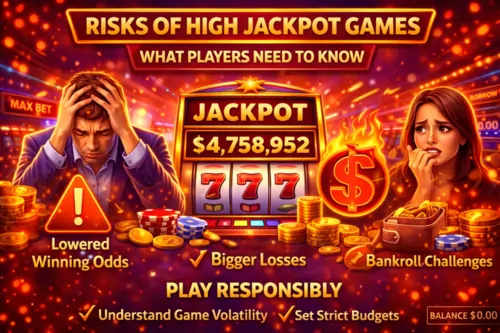
High jackpot games—especially big progressive, mega, and daily “must‑drop” slots—are some of the most exciting products in online casinos. They’re also among the riskiest, because they combine high volatility, strong emotional triggers, and the promise of life‑changing wins that are extremely unlikely to occur.
This guide explains the main risks of high jackpot games, how those risks show up in real play, and what you can do to protect yourself if you choose to play them. For mechanics‑first context, see our in‑depth guides on progressive jackpots, how jackpot pools grow, mega jackpot slot mechanics, fixed vs progressive jackpots, daily jackpot features, and responsible play in jackpot gaming.
What Counts as a “Risks of High Jackpot Games”?
High jackpot games are titles where the potential top prize is far above what a normal slot or table game would pay, typically:
- Large network progressive jackpot slots
- Mega jackpot or “millionaire‑maker” slots
- High‑ceiling daily / must‑drop jackpots
- Some table or specialty games with large pooled jackpots
These are usually online casino games or electronic gaming machines (EGMs), which research identifies as some of the highest‑risk gambling products for at‑risk and problem gambling.
Mechanically, they’re designed so:
- A very small number of players receive very large wins.
- Those wins are funded by many losing or small‑win sessions.
For detailed mechanics and comparisons, external explainers on progressive jackpots and slot volatility match what we cover in our own jackpot guides.
Core Mathematical Risks
1. High Volatility and Big Swings
High jackpot games are almost always high‑volatility:
- Wins are less frequent than on many standard slots.
- When wins come, they can be large—but they are rare and unpredictable.
- Long losing streaks are normal, even when the RTP is theoretically fair over millions of spins.
High‑volatility slots pack more of their long‑term “return” into rare events, which means everyday play feels swingy and often punishing. Guides on RTP and volatility and variance explained show the same pattern: big top prizes usually come with longer dry spells.
What this means for you:
- Your balance can drop quickly and unpredictably.
- You might see few meaningful wins in a session—or none at all.
- You need smaller stakes and stricter limits than for low‑volatility games.
2. Lower Effective Value (RTP in Practice)
Most high jackpot games reserve a slice of each bet to fund the jackpot(s):
- The jackpot contribution is part of the game’s Return to Player (RTP), not “free extra money”.
- Base‑game payouts are often trimmed to make room for jackpot funding.
- If you never hit the jackpot (the most likely outcome), the game can feel “tighter” than similar non‑jackpot slots.
In practice:
- Many standard online slots sit around relatively high RTP values.
- High‑jackpot titles often have overall RTP a bit lower, and more of that return is concentrated in rare wins.
- External guides like RTP decoded warn that jackpot games can trade regular value for rare big prizes.
Bottom line: You’re paying for a lottery‑style chance at a huge win, and that cost shows up as weaker day‑to‑day returns.
3. Rare, All‑or‑Nothing Payouts
The headline prize—the massive jackpot—is:
- Extremely unlikely to hit in any one session.
- Designed to be triggered only occasionally across a huge number of spins and often across many players and sites.
Your realistic outcomes are much more likely to be:
- Small and medium‑sized wins that don’t fully cover your total stakes, or
- Extended losing sessions with no major hit.
Studies of gambling consumption show that a small fraction of players generate a large share of losses, and that high‑risk continuous‑play products like online casino slots are disproportionately associated with harm.
Psychological and Behavioural Risks
1. “Jackpot Fever” and FOMO
Huge visible jackpots and “must drop” labels can create:
- Fear of missing out: “If I stop now, someone else will win what should have been mine.”
- Pressure to keep playing longer than planned or to re‑deposit quickly.
- Impulsive stake increases at the worst possible time.
GambleAware and other harm‑prevention resources list FOMO around “big opportunities” as a common driver of risky gambling choices.
2. Illusion of Control and “Due” Myths
Common risky thoughts include:
- “This jackpot is so big, it must be close to dropping.”
- “I’ve already put so much in; I’m due a big win soon.”
- “The machine is hot/cold based on my last few spins.”
In reality, on properly regulated online games:
- Each spin is independent, controlled by the RNG.
- The system does not remember what you’ve spent.
- The jackpot can drop for any eligible player at any time.
Public‑health and regulator assessments emphasise that high‑frequency, rapid‑play games (like online casino and EGMs) are particularly risky when players believe they can “time” or “beat” the game.
3. Chasing Losses
Because high jackpot games are emotional and volatile, many players:
- Raise stakes after losing periods to “win it back in one hit”.
- Extend sessions far beyond what they planned.
- Switch between jackpot games looking for a “lucky” one.
Responsible‑gambling guides highlight chasing losses as a key indicator of developing problems. See our dedicated guide on responsible play in jackpot gaming for practical anti‑chasing strategies.
Financial Risks
1. Fast Bankroll Depletion
Combine high volatility with high stakes and you get:
- Very fast losses when spins go badly.
- Sessions where a handful of unlucky spins wipes out your entire budget.
Guides like “understanding the risks of gambling” stress how high‑risk products can lead to rapid, unexpected losses when players don’t adjust stake size.
2. Debt and Borrowing
When you view jackpots as a way out of money problems:
- It becomes easy to justify using credit cards, loans, or borrowed money.
- A single big win can reinforce unsafe habits (“It saved me once; it might again”).
- Losses can turn into long‑term debt, missed bills, and financial distress.
WHO and other public‑health sources now explicitly list financial hardship, debt, and poverty as key harms linked to gambling.
3. Hidden Long‑Term Cost
Even “low” stakes add up over time:
- Regular small sessions on high‑jackpot games can cost more than one big night out.
- Because you rarely see the top prize, most of your spend disappears into the system without visible “payoff”.
GambleAware notes that many people underestimate their cumulative gambling spend until they look back over months of transactions.
Time, Mood, and Relationship Risks
1. Time Loss and Distraction
High jackpot games are built as rapid, continuous‑play products, which regulators identify as higher risk:
- Spins, bonuses, and growing meters make it easy to lose track of time.
- Long sessions can crowd out sleep, work, hobbies, and family time.
2. Mood and Mental Health
Repeated losses and chasing can lead to:
- Stress, anxiety, and shame about money and gambling.
- Feelings of hopelessness if you’re relying on jackpots to “fix” other problems.
- In more serious cases, depression and, according to WHO, an increased risk of suicidal thoughts or behaviour when gambling harm becomes severe.
Resources such as HelpGuide’s gambling addiction page and WHO‑linked fact sheets emphasise mental‑health impacts and the need for early support.
3. Relationship Strain
High‑risk gambling can strain relationships when:
- You hide or minimise gambling from partners, family, or friends.
- Money needed for shared expenses is used to gamble.
- Mood swings from wins and losses cause arguments or withdrawal.
GambleAware and government harm‑resources list relationship conflict and secrecy as common signs of escalating gambling problems.
How to Reduce Risk With High Jackpot Games
You can’t change the math of high‑jackpot games, but you can change how you interact with them.
1. Tight Money and Time Limits
Before you play:
- Set a fixed money limit you can comfortably afford to lose for this session and week/month.
- Set a time limit (for example, 30–60 minutes).
- Decide you will stop when either limit is reached, win or lose.
During play:
- Use small stakes relative to your budget and the game’s volatility.
- Don’t top up once your budget is gone.
- Don’t extend your session because “the jackpot looks close” or a timer is near zero.
2. Treat High Jackpot Games as a Small Side Bet
Use high jackpots as occasional high‑risk extras, not your main game:
- Spend most of your gambling budget on higher‑RTP, lower‑volatility titles if you want more consistent returns.
- Reserve a small slice (for example, 5–10% of your total budget) for progressive, mega, or daily jackpots.
- Assume you will not hit the top prize; any big win is a surprise, not a plan.
Our articles on fixed vs progressive jackpots and daily jackpot features can help you choose formats that match your risk tolerance.
3. Avoid Chasing and “Due” Thinking
When you catch yourself thinking:
- “I’m due a big win.”
- “I’ll just keep going until this drops.”
- “I need to win back what I lost tonight.”
Use that as a stop signal, not a reason to continue:
- Take a break immediately, away from the game and the screen.
- Remind yourself that every spin is independent and the jackpot is not “owed” to you.
- If you find it hard to stop once you’ve decided, that’s a sign your gambling may be getting risky.
Our dedicated guide on responsible play in jackpot gaming goes deeper into anti‑chasing strategies and emotional stop‑rules.
4. Use Safer‑Gambling Tools
Most reputable operators and regulators encourage safer play and offer tools such as:
- Deposit limits – cap how much you can deposit over a period.
- Loss limits – automatically stop play after a set loss.
- Reality checks / session pop‑ups – remind you how long you’ve been playing.
- Time‑outs / cooling‑off periods – short breaks if you feel things are getting too intense.
- Self‑exclusion – longer blocks if you need a complete reset.
The Responsible Gambling Council’s safer‑play tips, GambleAware’s risk advice, and government harm resources like OASAS gambling harms all recommend using these tools, especially with high‑risk products like online jackpot games.
When Risk Becomes Harmful
It’s time to take action if:
- You regularly spend more than you can afford on jackpots or other gambling.
- You borrow, use credit, or sell possessions to keep gambling.
- You hide or lie about your gambling from those close to you.
- You feel anxious, guilty, or low after playing but find it hard to stop.
- Gambling is affecting your sleep, work, studies, or relationships.
Public‑health and clinical resources (WHO fact sheets, systematic reviews, and help‑guides) consistently stress that gambling harm can escalate to serious mental‑health issues, including depression and suicidality, and that early support is crucial.
Steps you can take:
- Talk honestly with someone you trust about what’s been happening.
- Use blocking or self‑exclusion tools to create space from gambling if needed.
- Contact recognised gambling‑help services or helplines in your country or region; organisations like NCPG, RGC, and government health agencies list local options and self‑assessment tools.
Quick Safety Checklist Before You Chase a Big Jackpot
Before you start a session on a high jackpot game, ask yourself:
- Can I comfortably afford to lose the amount I’m planning to stake today?
- Have I set a money limit and a time limit, and do I have a plan to stop?
- Am I okay with the very real possibility of not winning anything significant?
- Do I fully accept that the big jackpot is extremely unlikely to hit for me?
- Am I willing to stop immediately if I feel angry, stressed, or tempted to chase losses?
If any answer is “no”, it’s safer to reduce your risk—by lowering stakes, choosing lower‑volatility games, using limits, or not playing at all.